

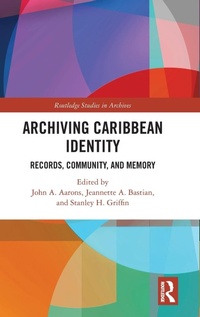
Archiving Caribbean Identity
Records, Community, and Memory
1st Edition
Published on 13. June 2022
Book
Hardback
248 pages
978-0-367-61509-3 (ISBN)
Description
Archiving Caribbean Identity highlights the "Caribbeanization" of archives in the region, considering what those archives could include in the future and exploring the potential for new records in new formats.
Interpreting records in the broadest sense, the 15 chapters in this volume explore a wide variety of records that represent new archival interpretations. The book is split into two parts, with the first part focusing on record forms that are not generally considered "archival" in traditional Western practice. The second part explores more "traditional" archival collections and demonstrates how these collections are analysed and presented from the perspective of Caribbean peoples. As a whole, the volume suggests how colonial records can be repurposed to surface Caribbean narratives. Reflecting on the unique challenges faced by developing countries as they approach their archives, the volume considers how to identify and archive records in the forms and formats that reflect the postcolonial and decolonized Caribbean, how to build an archive of the people that documents contemporary society and reflects Caribbean memory, and how to repurpose the colonial archives so that they assist the Caribbean in reclaiming its history.
Archiving Caribbean Identity demonstrates how non-textual cultural traces function as archival records and how folk-centred perspectives disrupt conventional understandings of records. The book should thus be of interest to academics and students engaged in the study of archives, memory, culture, history, sociology, and the colonial and postcolonial experience.
Interpreting records in the broadest sense, the 15 chapters in this volume explore a wide variety of records that represent new archival interpretations. The book is split into two parts, with the first part focusing on record forms that are not generally considered "archival" in traditional Western practice. The second part explores more "traditional" archival collections and demonstrates how these collections are analysed and presented from the perspective of Caribbean peoples. As a whole, the volume suggests how colonial records can be repurposed to surface Caribbean narratives. Reflecting on the unique challenges faced by developing countries as they approach their archives, the volume considers how to identify and archive records in the forms and formats that reflect the postcolonial and decolonized Caribbean, how to build an archive of the people that documents contemporary society and reflects Caribbean memory, and how to repurpose the colonial archives so that they assist the Caribbean in reclaiming its history.
Archiving Caribbean Identity demonstrates how non-textual cultural traces function as archival records and how folk-centred perspectives disrupt conventional understandings of records. The book should thus be of interest to academics and students engaged in the study of archives, memory, culture, history, sociology, and the colonial and postcolonial experience.
More details
Series
Language
English
Place of publication
London
United Kingdom
Publishing group
Taylor & Francis Ltd
Target group
Professional and scholarly
Postgraduate
Illustrations
22 s/w Abbildungen, 22 s/w Photographien bzw. Rasterbilder
22 Halftones, black and white; 22 Illustrations, black and white
Dimensions
Height: 240 mm
Width: 161 mm
Thickness: 19 mm
Weight
567 gr
ISBN-13
978-0-367-61509-3 (9780367615093)
Copyright in bibliographic data and cover images is held by Nielsen Book Services Limited or by the publishers or by their respective licensors: all rights reserved.
Schweitzer Classification
Other editions
Additional editions
John Aarons | Jeannette A. Bastian | Stanley Hazley Griffin
Archiving Caribbean Identity
Records, Community, and Memory
Book
05/2024
1st Edition
Routledge
€63.40
Shipment within 15-20 days
John Aarons | Jeannette A. Bastian | Stanley Hazley Griffin
Archiving Caribbean Identity
Records, Community, and Memory
E-Book
06/2022
1st Edition
Routledge
€55.49
Available for download
John Aarons | Jeannette A. Bastian | Stanley Hazley Griffin
Archiving Caribbean Identity
Records, Community, and Memory
E-Book
06/2022
1st Edition
Routledge
€55.49
Available for download
Persons
John A. Aarons, now retired, was Executive Director of the National Library of Jamaica (1992-2002), Government Archivist of Jamaica (2002-2008), and University Archivist of the University of the West Indies (2009-2014).
Jeannette A. Bastian is Emerita Professor at Simmons University. She is currently an Honorary Fellow in the Department of Library and Information at the University of the West Indies.
Stanley H. Griffin is Deputy Dean, Undergraduate Matters (Humanities), and Lecturer in Archival and Information Studies in the Faculty of Humanities and Education, Department of Library and Information Studies, at the University of the West Indies, Mona Jamaica.
Jeannette A. Bastian is Emerita Professor at Simmons University. She is currently an Honorary Fellow in the Department of Library and Information at the University of the West Indies.
Stanley H. Griffin is Deputy Dean, Undergraduate Matters (Humanities), and Lecturer in Archival and Information Studies in the Faculty of Humanities and Education, Department of Library and Information Studies, at the University of the West Indies, Mona Jamaica.
Content
Introduction; Part I. Tangible and Intangible Formats: Chapter 1. Soca and collective memory; Savannah Grass as an archive of Carnival; Chapter 2. Jamaican twitter as a repository for documenting memory and social resistance: Listening to the "articulate minority"; Chapter 3. Singing Our Caribbean Identity: Programming the UWI, Mona Festival of the Nine Lessons with Carols; Chapter 4. Archives "cast in stone": Memorials as memory; Chapter 5. Landscape as record: Archiving the Antigua Recreation Ground; Chapter 6. Concert Dance in Barbados as Archive: Dancing the national narratives; Chapter 7. Remembering an art exhibit: The Face of Jamaica, 1963-1964; Chapter 8. Traditional and new record sources in geointerpretive methods for reconstructing biophysical history: Whither Withywood; Part II. Collections Through a Caribbean Lens: Chapter 9. Resistance in/and the Pre-Emancipation Archives; Chapter 10. Postcolonial philately as memory and history: Stamping a new identity for Trinidad and Tobago; Chapter 11. Recasting Jamaican sculptor Ronald Moody (1900 - 1984): An archival homecoming; Chapter 12. St. Lucian memory and identity through the eyes of John Robert Lee; Chapter 13. Crop Over and Carnival in the archives of Barbados and Trinidad and Tobago; Chapter 14. Ecclesiastical Records as Sources of Social History; The Anglican Church of Trinidad and Tobago; Chapter 15. Erasure and retention in Jamaica's official memory; The case of the disappearing telegrams; Index.