

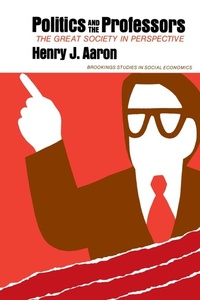
Politics and the Professors
The Great Society in Perspective
Published on 1. February 1978
Book
Paperback/Softback
200 pages
978-0-8157-0025-8 (ISBN)
Description
In the early 1960s America was in a confident mood and embarked on a series of efforts to solve the problems of poverty, racial discrimination, unemployment, and inequality of educational opportunity. The programs of the Great Society and the War on Poverty were undergirded by a broad consensus about what our problems as a nation were and how we should solve them. But by the early seventies both political and scholarly tides had shifted. Americans were divided and uncertain about what to do abroad, fearful of military inferiority, and pessimistic about the capacity of government to deal affirmatively with domestic problems. A new administration renounced the rhetoric of the Great Society and changed the emphasis of many programs. On the scholarly front, new research called into question the old faiths on which liberal legislation had been based.
In this book, the sixteenth volume in the Brookings series in Social Economics, Henry Aaron describes both the initial consensus and its subsequent decline. He examines the evolution of attitude and pronouncements by scholars and popular writers on the role of the federal government and its capacity to bring about beneficial change in three broad areas: poverty and discrimination, education and training, and unemployment and inflation. He argues that the political eclipse of the Great Society depended more on events external to it?war in Vietnam, dissolution of the civil rights coalition, and, finally, the Watergate scandal and all its repercussions?than on its intrinsic failings. Aaron concludes that both the initial commitment to use national polices to solve social and economic problems and the subsequent disillusionment of scholars and laymen alike rest largely on preconceptions and faiths that have little to do with research themselves.
In this book, the sixteenth volume in the Brookings series in Social Economics, Henry Aaron describes both the initial consensus and its subsequent decline. He examines the evolution of attitude and pronouncements by scholars and popular writers on the role of the federal government and its capacity to bring about beneficial change in three broad areas: poverty and discrimination, education and training, and unemployment and inflation. He argues that the political eclipse of the Great Society depended more on events external to it?war in Vietnam, dissolution of the civil rights coalition, and, finally, the Watergate scandal and all its repercussions?than on its intrinsic failings. Aaron concludes that both the initial commitment to use national polices to solve social and economic problems and the subsequent disillusionment of scholars and laymen alike rest largely on preconceptions and faiths that have little to do with research themselves.
More details
Language
English
Place of publication
United States
Publishing group
Bloomsbury Publishing Plc
Target group
Professional and scholarly
Product notice
Paperback (trade)
Dimensions
Height: 230 mm
Width: 154 mm
Thickness: 14 mm
Weight
299 gr
ISBN-13
978-0-8157-0025-8 (9780815700258)
Copyright in bibliographic data and cover images is held by Nielsen Book Services Limited or by the publishers or by their respective licensors: all rights reserved.
Schweitzer Classification
Other editions
Additional editions

E-Book
12/2010
1st Edition
Brookings Institution
€20.49
Available for download

E-Book
12/2010
Brookings Institution
€20.49
Available for download
Person
Henry J. Aaron is a senior fellow in Economic Studies at the Brookings Institution, where he holds the Bruce and Virginia MacLaury Chair. Among his many books are Can We Say No? The Challenge of Rationing Health Care, with William B. Schwartz and Melissa Cox (Brookings, 2006), and Reforming Medicare: Options,Tradeoffs, and Opportunities, written with Jeanne Lambrew (Brookings, 2008).