

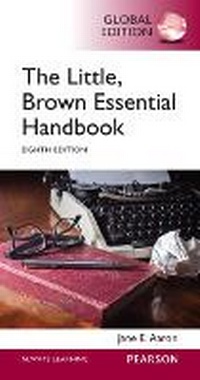
Little, Brown Essential Handbook, The, Global Edition
8th Edition
Published on 22. September 2014
Book
Paperback/Softback
312 pages
978-1-292-05995-2 (ISBN)
Description
For first year composition and undergraduate courses across the curriculum. The Little, Brown Essential Handbook , Eighth Edition, is a brief, accessible, and inexpensive pocket-sized handbook that answers questions about writing in the disciplines, the writing process, grammar and usage, research writing, and documentation. Teaching and Learning Experience This text will provide a better teaching and learning experience-for you and your students. It provides: ? Minimal terminology, clear explanations and examples, and pointers for ESL writers: Help students at all levels of learning. ? Extensive sections on academic writing, research writing, source documentation, and document design: Support writers in all disciplines. ? Convenient pocket size, four-color design, spiral binding, and numerous reference aids: Make the book convenient to carry and easy to use.
More details
Edition
8th edition
Language
English
Place of publication
Harlow
United Kingdom
Target group
College/higher education
Dimensions
Height: 215 mm
Width: 117 mm
Thickness: 11 mm
Weight
274 gr
ISBN-13
978-1-292-05995-2 (9781292059952)
Copyright in bibliographic data and cover images is held by Nielsen Book Services Limited or by the publishers or by their respective licensors: all rights reserved.
Schweitzer Classification
Other editions
Additional editions
Jane E. Aaron
Little, Brown Essential Handbook, Global Edition
E-Book
03/2015
1st Edition
Pearson Education Limited
€43.86
Available for download
Previous edition
Book
11/2013
7th Edition
Pearson Education Limited
€66.95
Article exhausted; check for reprint
Content
Finding What You Need 00
Preface 0
PART 1 WRITING
Essentials
1 Academic Writing
a The writing situation
b Thesis and organization
c Evidence and research
d Synthesis
e Responsible use of sources
f Language
g Revision
h Editing and proofreading
2 Writing Arguments
a Elements of argument
b Balance in argument
c Organization of argument
d Visual arguments
e Sample argument
3 Writing in the Disciplines
a Literature
b Other humanities
c Social sciences
d Natural and applied sciences
4 Presenting Writing
a Formats for academic papers
b Visuals and other media
c Oral presentations
d Readers with vision loss
PART 2 EFFECTIVE SENTENCES
Essentials
5 Emphasis
a Subjects and verbs
b Sentence beginnings and endings
c Coordination
d Subordination
6 Conciseness
a Focusing on the subject and verb
b Cutting empty words
c Cutting unneeded repetition
d Reducing clauses and phrases
e Revising there is or it is
f Combining sentences
7 Parallelism
a With and, but, or nor, yet
b With both...and, either...or, etc.
c With lists, headings, outlines
8 Variety and Detail
a Varied sentence lengths and structures
b Details
9 Appropriate Words
a Nonstandard dialect
b Slang
c Colloquial language
d Technical words
e Indirect and pretentious writing
f Sexist and other biased language
10 Exact Words
a Right word for meaning
b Concrete and specific words
c Idioms
d Cliches
PART 3 GRAMMATICAL SENTENCES
Essentials
VERBS
11 Forms
a Sing/sang/sung and other irregular verbs
b Helping verbs
c Verb + gerund or infinitive
d Verb + participle
12 Tenses
a Present tense (sing)
b Perfect tenses (have/had/will have sung)
c Consistency
d Sequence
13 Mood
a Subjunctive (I wish I were)
b Consistency
14 Voice
a She wrote it (active) vs. It was written (passive)
b Consistency
15 Subject-Verb Agreement
a -s ending for noun or verb
b Words between subject and verb
c Subjects with and
d Subjects with or or nor
e Everyone and other indefinite pronouns
f Team and other collective nouns
g Who, which, that
h News and other singular nouns ending in -s
i Inverted word order
j Is, are, and other linking verbs
PRONOUNS
16 Forms
a She and I vs. her and me
b It was she vs. It was her
c Who vs. whom
d Other constructions
17 Pronoun-Antecedent Agreement
a Antecedents with and
b Antecedents wi
Preface 0
PART 1 WRITING
Essentials
1 Academic Writing
a The writing situation
b Thesis and organization
c Evidence and research
d Synthesis
e Responsible use of sources
f Language
g Revision
h Editing and proofreading
2 Writing Arguments
a Elements of argument
b Balance in argument
c Organization of argument
d Visual arguments
e Sample argument
3 Writing in the Disciplines
a Literature
b Other humanities
c Social sciences
d Natural and applied sciences
4 Presenting Writing
a Formats for academic papers
b Visuals and other media
c Oral presentations
d Readers with vision loss
PART 2 EFFECTIVE SENTENCES
Essentials
5 Emphasis
a Subjects and verbs
b Sentence beginnings and endings
c Coordination
d Subordination
6 Conciseness
a Focusing on the subject and verb
b Cutting empty words
c Cutting unneeded repetition
d Reducing clauses and phrases
e Revising there is or it is
f Combining sentences
7 Parallelism
a With and, but, or nor, yet
b With both...and, either...or, etc.
c With lists, headings, outlines
8 Variety and Detail
a Varied sentence lengths and structures
b Details
9 Appropriate Words
a Nonstandard dialect
b Slang
c Colloquial language
d Technical words
e Indirect and pretentious writing
f Sexist and other biased language
10 Exact Words
a Right word for meaning
b Concrete and specific words
c Idioms
d Cliches
PART 3 GRAMMATICAL SENTENCES
Essentials
VERBS
11 Forms
a Sing/sang/sung and other irregular verbs
b Helping verbs
c Verb + gerund or infinitive
d Verb + participle
12 Tenses
a Present tense (sing)
b Perfect tenses (have/had/will have sung)
c Consistency
d Sequence
13 Mood
a Subjunctive (I wish I were)
b Consistency
14 Voice
a She wrote it (active) vs. It was written (passive)
b Consistency
15 Subject-Verb Agreement
a -s ending for noun or verb
b Words between subject and verb
c Subjects with and
d Subjects with or or nor
e Everyone and other indefinite pronouns
f Team and other collective nouns
g Who, which, that
h News and other singular nouns ending in -s
i Inverted word order
j Is, are, and other linking verbs
PRONOUNS
16 Forms
a She and I vs. her and me
b It was she vs. It was her
c Who vs. whom
d Other constructions
17 Pronoun-Antecedent Agreement
a Antecedents with and
b Antecedents wi