

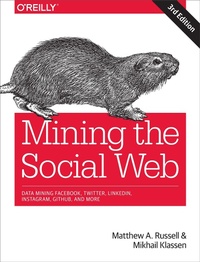
Mining the Social Web
Data Mining Facebook, Twitter, LinkedIn, Instagram, GitHub, and More
3rd Edition
Published on 31. January 2019
Book
Paperback/Softback
432 pages
978-1-4919-8504-5 (ISBN)
Description
Mine the rich data tucked away in popular social websites such as Twitter, Facebook, LinkedIn, and Instagram. With the third edition of this popular guide, data scientists, analysts, and programmers will learn how to glean insights from social media-including who's connecting with whom, what they're talking about, and where they're located-using Python code examples, Jupyter notebooks, or Docker containers.
In part one, each standalone chapter focuses on one aspect of the social landscape, including each of the major social sites, as well as web pages, blogs and feeds, mailboxes, GitHub, and a newly added chapter covering Instagram. Part two provides a cookbook with two dozen bite-size recipes for solving particular issues with Twitter.
Get a straightforward synopsis of the social web landscape
Use Docker to easily run each chapter's example code, packaged as a Jupyter notebook
Adapt and contribute to the code's open source GitHub repository
Learn how to employ best-in-class Python 3 tools to slice and dice the data you collect
Apply advanced mining techniques such as TFIDF, cosine similarity, collocation analysis, clique detection, and image recognition
Build beautiful data visualizations with Python and JavaScript toolkits
In part one, each standalone chapter focuses on one aspect of the social landscape, including each of the major social sites, as well as web pages, blogs and feeds, mailboxes, GitHub, and a newly added chapter covering Instagram. Part two provides a cookbook with two dozen bite-size recipes for solving particular issues with Twitter.
Get a straightforward synopsis of the social web landscape
Use Docker to easily run each chapter's example code, packaged as a Jupyter notebook
Adapt and contribute to the code's open source GitHub repository
Learn how to employ best-in-class Python 3 tools to slice and dice the data you collect
Apply advanced mining techniques such as TFIDF, cosine similarity, collocation analysis, clique detection, and image recognition
Build beautiful data visualizations with Python and JavaScript toolkits
More details
Edition
3rd New edition
Language
English
Place of publication
Sebastopol
United States
Target group
Professional and scholarly
Edition type
New edition
Product notice
Paperback (trade)
Unsewn / adhesive bound
Dimensions
Height: 233 mm
Width: 180 mm
Thickness: 30 mm
Weight
735 gr
ISBN-13
978-1-4919-8504-5 (9781491985045)
Copyright in bibliographic data and cover images is held by Nielsen Book Services Limited or by the publishers or by their respective licensors: all rights reserved.
Schweitzer Classification
Other editions
Additional editions
Matthew A. Russell
Mining the Social Web
Data Mining Facebook, Twitter, LinkedIn, Instagram, GitHub, and More
E-Book
12/2018
O'Reilly
€42.49
Available for download
Matthew A. Russell
Mining the Social Web
Data Mining Facebook, Twitter, LinkedIn, Instagram, GitHub, and More
E-Book
12/2018
O'Reilly
€50.99
Available for download
Previous edition
Matthew A. Russell
Mining the Social Web
Data Mining Facebook, Twitter, LinkedIn, Google+, GitHub, and More
Book
10/2013
2nd Edition
O'Reilly
€37.00
Article exhausted; check for reprint
Persons
Matthew Russell, Chief Technology Officer at Digital Reasoning, Principal at Zaffra, and author of several books on technology including Mining the Social Web (O'Reilly, 2013), now in its second edition. He is passionate about open source software development, data mining, and creating technology to amplify human intelligence. Matthew studied computer science and jumped out of airplanes at the United States Air Force Academy. When not solving hard problems, he enjoys practicing Bikram Hot Yoga, CrossFitting and participating in triathlons. Mikhail Klassen is co-founder and Chief Data Scientist at Paladin:Paradigm, an aerospace analytics startup based in Montreal.His PhD research work was in large-scale numerical simulations of star formation, where he implemented a novel radiative transfer technique that led to more accurate models of the birth environments of high-mass stars.