

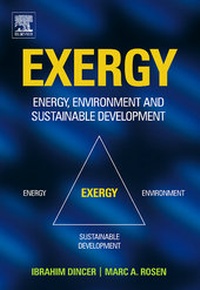
Exergy
Energy, Environment and Sustainable Development
Published on 18. September 2007
Book
Hardback
472 pages
978-0-08-044529-8 (ISBN)
Description
This book deals with exergy and its applications to various energy systems and applications as a potential tool for design, analysis and optimization, and its role in minimizing and/or eliminating environmental impacts and providing sustainable development. In this regard, several key topics ranging from the basics of the thermodynamic concepts to advanced exergy analysis techniques in a wide range of applications are covered as outlined in the contents.
More details
Language
English
Place of publication
Oxford
United Kingdom
Publishing group
Elsevier Science & Technology
Target group
Professional and scholarly
Upper-level undergraduate students and graduate students, researchers, scientists and engineers studying or working in mechanical, chemical, energy, environmental, process, and industrial engineering.
Dimensions
Height: 246 mm
Width: 189 mm
Weight
1110 gr
ISBN-13
978-0-08-044529-8 (9780080445298)
Copyright in bibliographic data and cover images is held by Nielsen Book Services Limited or by the publishers or by their respective licensors: all rights reserved.
Schweitzer Classification
Other editions
New editions
Book
11/2012
2nd Edition
Elsevier
€120.08
Article exhausted; check for reprint
Additional editions
E-Book
09/2007
Elsevier
€165.00
Available for download
Persons
Marc A. Rosen is a professor at Ontario Tech University (formally University of Ontario Institute of Technology) in Oshawa, Canada, where he served as founding Dean of the Faculty of Engineering and Applied Science. He is also the Editor-in-Chief of the International Journal of Energy and Environmental Engineering and the founding Editor-in-Chief of Sustainability. He has written numerous books and journal articles. Professor Rosen received the President's Award from the Canadian Society for Mechanical Engineering in 2012. He is an active teacher and researcher in sustainable energy, environmental impact of energy and industrial systems, and energy technology (including heat transfer and recovery, renewable energy and efficiency improvement). His work on exergy methods in applied thermodynamics has been pioneering and led to many informative and useful findings. He has carried out research on linkages between thermodynamics and environmental impact and ecology. Much of his research has been carried out for industry. Dr. Ibrahim Dincer is professor of Mechanical Engineering at the Ontario Tech. University and visiting professor at Yildiz Technical University. He has authored numerous books and book chapters, and many refereed journal and conference papers. He has chaired many national and international conferences, symposia, workshops, and technical meetings. He has also delivered many plenary, keynote and invited lectures. He is an active member of various international scientific organizations and societies, and serves as editor in chief, associate editor, regional editor, and editorial board member for various prestigious international journals. He is a recipient of several research, teaching and service awards, including the Premier?s Research Excellence Award in Ontario, Canada. For the past seven years in a row he has been recognized by Thomson Reuters as one of The Most Influential Scientific Minds in Engineering and one of the Most Highly Cited Researchers. Marc A. Rosen is founding Dean of Engineering and Applied Science at the University of Ontario Institute of Technology in Oshawa, Canada. A Past-President of the Canadian Society for Mechanical Engineering, Dr. Rosen received an Award of Excellence in Research and Technology Development from the Ontario Ministry of Environment and Energy, and is a Fellow of the Engineering Institute of Canada, the American Society of Mechanical Engineers, the Canadian Society for Mechanical Engineering, and the International Energy Foundation. He has worked for Imatra Power Company in Finland, Argonne National Laboratory, and the Institute for Hydrogen Systems, near Toronto.
Content
Preface
Acknowledgement
Chapter 1. Thermodynamic Fundamentals
Chapter 2. Energy and Exergy Analyses
Chapter 3. Exergy, Environment and Sustainable Development
Chapter 4. Exergy of Applications by Industry
Chapter 5. Exergy in Policy Development and Education
Chapter 6. Exergy Analysis of Psychrometric Processes
Chapter 7. Exergy Analysis of Heat Pump Systems
Chapter 8. Exergy Analysis of Drying Processes and Systems
Chapter 9. Exergy Analysis of Thermal Energy Storage Systems
Chapter 10. Exergy Analysis of Renewable Energy Systems
Chapter 11. Exergy Analysis of Steam Power Plants
Chapter 12. Exergy Analysis of Cogeneration and District Energy Systems
Chapter 13. Exergy Analysis of Cryogenic Systems
Chapter 14. Exergy Analysis of Crude Oil Distillation Systems
Chapter 15. Exergy Analysis of Fuel Cell Systems
Chapter 16. Exergy Analysis of Aircraft Systems
Chapter 17. Exergoeconomic Analysis of Thermal Systems
Chapter 18. Sectoral Exergy Analysis
Chapter 19. Exergetic Life Cycle Assessment
Chapter 20. Exergy and Industrial Ecology
Nomenclature
References
Appendix A. Glossary
Appendix B. Conversion Factors
Appendix C. Thermophysical Properties
Subject Index
Acknowledgement
Chapter 1. Thermodynamic Fundamentals
Chapter 2. Energy and Exergy Analyses
Chapter 3. Exergy, Environment and Sustainable Development
Chapter 4. Exergy of Applications by Industry
Chapter 5. Exergy in Policy Development and Education
Chapter 6. Exergy Analysis of Psychrometric Processes
Chapter 7. Exergy Analysis of Heat Pump Systems
Chapter 8. Exergy Analysis of Drying Processes and Systems
Chapter 9. Exergy Analysis of Thermal Energy Storage Systems
Chapter 10. Exergy Analysis of Renewable Energy Systems
Chapter 11. Exergy Analysis of Steam Power Plants
Chapter 12. Exergy Analysis of Cogeneration and District Energy Systems
Chapter 13. Exergy Analysis of Cryogenic Systems
Chapter 14. Exergy Analysis of Crude Oil Distillation Systems
Chapter 15. Exergy Analysis of Fuel Cell Systems
Chapter 16. Exergy Analysis of Aircraft Systems
Chapter 17. Exergoeconomic Analysis of Thermal Systems
Chapter 18. Sectoral Exergy Analysis
Chapter 19. Exergetic Life Cycle Assessment
Chapter 20. Exergy and Industrial Ecology
Nomenclature
References
Appendix A. Glossary
Appendix B. Conversion Factors
Appendix C. Thermophysical Properties
Subject Index