

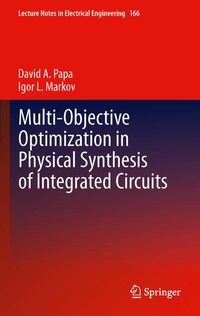
Multi-Objective Optimization in Physical Synthesis of Integrated Circuits
Published on 8. August 2012
Book
Hardback
X, 158 pages
978-1-4614-1355-4 (ISBN)
Description
This book introduces techniques that advance the capabilities and strength of modern software tools for physical synthesis, with the ultimate goal to improve the quality of leading-edge semiconductor products. It provides a comprehensive introduction to physical synthesis and takes the reader methodically from first principles through state-of-the-art optimizations used in cutting edge industrial tools. It explains how to integrate chip optimizations in novel ways to create powerful circuit transformations that help satisfy performance requirements.
More details
Series
Edition
2012 ed.
Language
English
Place of publication
New York
United States
Target group
Professional and scholarly
Research
Illustrations
X, 158 p.
Dimensions
Height: 241 mm
Width: 160 mm
Thickness: 13 mm
Weight
424 gr
ISBN-13
978-1-4614-1355-4 (9781461413554)
DOI
10.1007/978-1-4614-1356-1
Schweitzer Classification
Other editions
Additional editions
David A. Papa | Igor L. Markov
Multi-Objective Optimization in Physical Synthesis of Integrated Circuits
Book
09/2014
Springer
€106.99
Shipment within 15-20 days
David A. Papa | Igor L. Markov
Multi-Objective Optimization in Physical Synthesis of Integrated Circuits
E-Book
08/2012
1st Edition
Springer
€96.29
Available for download
Content
Part I: Introduction and Prior Art.- Timing Closure for Multi-Million-Gate Integrated Circuits.- State of the Art in Physical Synthesis.- Part II: Local Physical Synthesis and Necessary Analysis Techniques.- Buffer Insertion during Timing-Driven Placement.- Bounded Transactional Timing Analysis.- Gate Sizing During Timing-Driven Placement.- Part III: Broadening the Scope of Circuit Transformations.- Physically-Driven Logic Restructuring.- Logic Restructuring as an Aid to Physical Retiming.- Broadening the Scope of Optimization using Partitioning.- Co-Optimization of Latches and Clock Networks.- Conclusions and Future Work.