

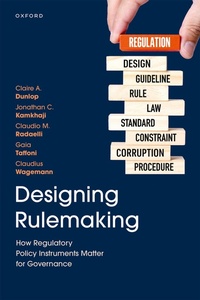
Designing Rulemaking
How Regulatory Policy Instruments Matter for Governance
Published on 24. December 2024
Book
Hardback
224 pages
978-0-19-286896-1 (ISBN)
Description
This is an open access title available under the terms of a CC BY-NC-ND 4.0 International licence. It is free to read on the Oxford Academic platform and offered as a free PDF download from OUP and selected open access locations.
Over the last twenty-five years, many governments around the world have adopted access to information legislation, introduced or re-designed impact assessment procedures for proposed legislation, created ombudsman offices, and engaged stakeholders in various types of consultation. With a general aim of making rulemaking more transparent and inclusive and ultimately more efficient, these governments - nudged by the advocacy of International Organizations - have reformed the design of their rulemaking procedures and calibrated them in specific yet distinct ways. The question arises: do these innovations, designed to open up rulemaking process and make regulation better, have an actual effect on policy and governance outcomes?
In Designing Rulemaking, the authors answer this question with a novel, purpose-built dataset on regulatory design based on the legal provisions disciplining four rulemaking procedures - impact assessment, stakeholder consultation, freedom of information, and ombudsman procedures.
Examining twenty-eight countries (the EU twenty-seven plus the UK), the dataset operationalises rules as data and measures the design features of each procedure in each country. The authors then, using set-theoretic methods, consider the effects of these combinations of designs of rulemaking procedures on the quality of the business environment, perception of corruption, and environmental performance. Their findings shatter predominant views on policy change in Europe and offer a varied, detailed, granular account of the efficacy of regulatory design.
Over the last twenty-five years, many governments around the world have adopted access to information legislation, introduced or re-designed impact assessment procedures for proposed legislation, created ombudsman offices, and engaged stakeholders in various types of consultation. With a general aim of making rulemaking more transparent and inclusive and ultimately more efficient, these governments - nudged by the advocacy of International Organizations - have reformed the design of their rulemaking procedures and calibrated them in specific yet distinct ways. The question arises: do these innovations, designed to open up rulemaking process and make regulation better, have an actual effect on policy and governance outcomes?
In Designing Rulemaking, the authors answer this question with a novel, purpose-built dataset on regulatory design based on the legal provisions disciplining four rulemaking procedures - impact assessment, stakeholder consultation, freedom of information, and ombudsman procedures.
Examining twenty-eight countries (the EU twenty-seven plus the UK), the dataset operationalises rules as data and measures the design features of each procedure in each country. The authors then, using set-theoretic methods, consider the effects of these combinations of designs of rulemaking procedures on the quality of the business environment, perception of corruption, and environmental performance. Their findings shatter predominant views on policy change in Europe and offer a varied, detailed, granular account of the efficacy of regulatory design.
More details
Language
English
Place of publication
Oxford
United Kingdom
Target group
Professional and scholarly
Product notice
sewn/stitched
Cloth over boards
Dimensions
Height: 235 mm
Width: 164 mm
Thickness: 20 mm
Weight
499 gr
ISBN-13
978-0-19-286896-1 (9780192868961)
Copyright in bibliographic data and cover images is held by Nielsen Book Services Limited or by the publishers or by their respective licensors: all rights reserved.
Schweitzer Classification
Other editions
Additional editions
Claire A. Dunlop | Jonathan C. Kamkhaji | Claudio M. Radaelli
Designing Rulemaking
How Regulatory Policy Instruments Matter for Governance
E-Book
12/2024
OUP eBook
€77.99
Available for download
Claire A. Dunlop | Jonathan C. Kamkhaji | Claudio M. Radaelli
Designing Rulemaking
How Regulatory Policy Instruments Matter for Governance
E-Book
11/2024
OUP eBook
€77.99
Available for download
Persons
Claire A. Dunlop is a Professor of Politics and Public Policy at the University of Exeter. She has more than 80 academic publications on research interests including policy process theories, LGBTQ+ politics, and science and public policy. Claire was Vice Chair of the UK Political Studies Association and is an editor of Policy & Politics.
Jonathan C. Kamkhaji is a Post-Doctoral Research Fellow at the School of Transnational Governance of the European University Institute, Florence. His research interests include public policy, regulation, governance, and European integration. He has worked as a policy consultant for the World Bank and has published research in leading international journals and presses.
Claudio M. Radaelli is Professor of Public Policy at University College London, on leave at the European University Institute (EUI) where he is full-time Professor and Academic Coordinator of the Policy Leaders Fellowship Program. He has published more than 80 peer-reviewed articles and authored/edited 11 books on learning in public policy, narratives, regulation, and governance. Claudio was awarded two advanced grants by the European Research Council. He is editor-in-chief of International Review of Public Policy.
Gaia Taffoni is a Research Fellow at the Florence School of Transnational Governance where she teaches policy evaluation. She has published research in leading international journals. Her current research focuses on regulatory governance and examines the role of evidence in public policy and public administration.
Claudius Wagemann is a Professor for Political Science Methods at Goethe University, Frankfurt, and a part-time Professor at the School of Transnational Governance, European University Institute (EUI), Florence. He has published on comparative case study methods, such as Qualitative Comparative Analysis (QCA), and works on topics connected to the use of methods in the discipline of political science.
Jonathan C. Kamkhaji is a Post-Doctoral Research Fellow at the School of Transnational Governance of the European University Institute, Florence. His research interests include public policy, regulation, governance, and European integration. He has worked as a policy consultant for the World Bank and has published research in leading international journals and presses.
Claudio M. Radaelli is Professor of Public Policy at University College London, on leave at the European University Institute (EUI) where he is full-time Professor and Academic Coordinator of the Policy Leaders Fellowship Program. He has published more than 80 peer-reviewed articles and authored/edited 11 books on learning in public policy, narratives, regulation, and governance. Claudio was awarded two advanced grants by the European Research Council. He is editor-in-chief of International Review of Public Policy.
Gaia Taffoni is a Research Fellow at the Florence School of Transnational Governance where she teaches policy evaluation. She has published research in leading international journals. Her current research focuses on regulatory governance and examines the role of evidence in public policy and public administration.
Claudius Wagemann is a Professor for Political Science Methods at Goethe University, Frankfurt, and a part-time Professor at the School of Transnational Governance, European University Institute (EUI), Florence. He has published on comparative case study methods, such as Qualitative Comparative Analysis (QCA), and works on topics connected to the use of methods in the discipline of political science.
Author
Professor of Public Policy and Politics, Department of PoliticsProfessor of Public Policy and Politics, Department of Politics, University of Exeter
Post-Doctoral Research FellowPost-Doctoral Research Fellow, Florence School of Transnational Governance of the European University Institute
Professor of Public Policy and Professor of Comparative Public PolicyProfessor of Public Policy and Professor of Comparative Public Policy, University College London and European University Institute
Research FellowResearch Fellow, Florence School of Transnational Governance, European University Institute
Full Professor, Department of Political ScienceFull Professor, Department of Political Science, Goethe University Frankfurt
Content
List of Figures
List of Tables
List of Abbreviations
1: Does the Regulatory Reform Agenda Matter?
2: Design in Governance and Design for Governance
3: Measuring Rulemaking: A Theory-Informed Approach
4: Ease of Doing Business
5: Perception of Corruption
6: Environmental Performance
7: Conclusions
List of Tables
List of Abbreviations
1: Does the Regulatory Reform Agenda Matter?
2: Design in Governance and Design for Governance
3: Measuring Rulemaking: A Theory-Informed Approach
4: Ease of Doing Business
5: Perception of Corruption
6: Environmental Performance
7: Conclusions