

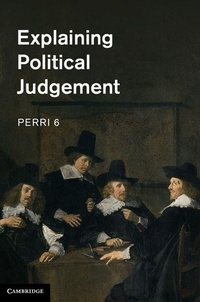
Explaining Political Judgement
1st Edition
Published on 22. September 2011
Book
Hardback
354 pages
978-1-107-00922-6 (ISBN)
Description
What is political judgement? Why do politicians exhibit such contrasting thought styles in making decisions, even when they agree ideologically? What happens when governments with contrasting thought styles have to deal with each other? In this book Perri 6 presents a fresh, rigorous explanatory theory of judgement, its varieties and its consequences, drawing upon Durkheim and Douglas. He argues that policy makers will understand - and misunderstand - their problems and choices in ways that reproduce their own social organisation. This theory is developed by using the Cuban Missile Crisis of 1962 as an extended case study, examining the decision-making of the Kennedy, Castro and Khrushchev regimes. Explaining Political Judgement is the first comprehensive study to show what a neo-Durkheimian institutional approach can offer to political science and to the social sciences generally.
Reviews / Votes
'Drawing upon neo-Durkheimian social anthropology, Perri 6 demonstrates the profound relevance of social and institutional context to an old issue (political judgment) in a familiar historical case (the Cuban Missile Crisis). This bold, refreshing, deeply fascinating cross-disciplinary foray challenges us to rethink our understandings of both.' David A. Welch, CIGI Chair of Global Security, Balsillie School of International Affairs 'It requires a good deal of courage to undertake an analysis of the Cuban Missile Crisis, given the iconic status of ... Essence of Decision. Perri 6 has, however, done just that and done it in an interesting and important way. One does not have to agree with the arguments, but they can not be ignored. This is a fresh and theoretically intriguing approach to political judgment in general and the Crisis in particular.' B. Guy Peters, Maurice Falk Professor of American Government, University of PittsburghMore details
Language
English
Place of publication
Cambridge
United Kingdom
Target group
Professional and scholarly
Illustrations
5 Tables, black and white; 6 Line drawings, unspecified
Dimensions
Height: 235 mm
Width: 157 mm
Thickness: 24 mm
Weight
666 gr
ISBN-13
978-1-107-00922-6 (9781107009226)
Copyright in bibliographic data and cover images is held by Nielsen Book Services Limited or by the publishers or by their respective licensors: all rights reserved.
Schweitzer Classification
Other editions
Additional editions
Perri 6
Explaining Political Judgement
Book
01/2015
Cambridge University Press
€51.50
Shipment within 15-20 days
Perri 6
Explaining Political Judgement
E-Book
11/2011
1st Edition
Cambridge University Press
€24.99
Available for download
E-Book
09/2011
Cambridge University Press
€26.99
Available for download
Person
Perri 6 is Professor of Social Policy in the Graduate School of the College of Business, Law and Social Sciences at Nottingham Trent University. He worked previously at the University of Birmingham, King's College London, the University of Strathclyde and the University of Bath. His recent books include Principles of Research Design (2011, with C. Bellamy), Paradoxes of Modernisation: Unintended Consequences of Public Policy Reform (2010, edited with H. Margetts and C. Hood), The Institutional Dynamics of Culture: The New Durkheimians, Volumes I and II (2008, edited with G. Mars), Public Emotions (2007, edited with S. Radstone, C. Squire and A. Treacher) Beyond Delivery: Policy Implementation as Sense-Making and Settlement (2006, with E. Peck), Managing Networks of Twenty First Century Organisations (2006, with N. Goodwin, E. Peck and T. Freeman) and E-Governance: Styles of Political Judgment in the Information Age Polity (2004). He currently holds a Leverhulme Trust Major Research Fellowship which supports his research on unintended and unanticipated consequences of political judgement styles in British government, 1959-74.
Content
1. On political judgement; 2. The need for richer explanation; 3. A Durkheimian theoretical framework; 4. October 1962, before and after; 5. The Khrushchev regime; 6. The Kennedy administration; 7. The Castro revolutionary regime; 8. Implications; 9. Coda.