

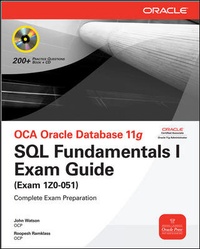
OCA Oracle Database 11g: SQL Fundamentals I Exam Guide (Exam 1Z0-051)
Will be published approx. on 16. August 2008
Audio
CD-Extra
978-0-07-026499-1 (ISBN)
Unfortunately, price unknown
Not yet published
Not available
More details
Language
English
Place of publication
India
Publishing group
McGraw-Hill Education
Dimensions
Height: 242 mm
Width: 185 mm
Thickness: 28 mm
ISBN-13
978-0-07-026499-1 (9780070264991)
Copyright in bibliographic data and cover images is held by Nielsen Book Services Limited or by the publishers or by their respective licensors: all rights reserved.
Schweitzer Classification
Persons
Author
John Watson (UK) OCP DBA 8.0, 8.i, & 9i, 10g, 11g, Interrnet Application Server Administrator, and certified on Managing Oracle on Unix, is a senior consultant with BLP Management Consultants, and taught for Oracle University in South Africa for four years. John taught the DB10g New Features course, the DB10g Manageability and Performance seminars. He validated hundreds of OCP 10g New Features exam questions and contributed to the course material for all the 10g courses. John is the author of numerous articles on technology.
Roopesh Ramklass, OCM, is a technical specialist with 10 years of experience in a wide variety of IT environments, including software development, system administration, systems analysis, software design, systems architecture, courseware development, and lecturing. Ramklass is experienced in managing and executing IT development projects, including infrastructure systems provisioning, software development, and systems integration.
Content
Chapter 1. Oracle Server Technologies and the Relational Paradigm
Chapter 2. Data Retrieval Using the SQL SELECT Statement
Chapter 3. Restricting and Sorting Data
Chapter 4. Single-Row Function
Chapter 5. Using Conversion Functions and Conditional Expressions
Chapter 6. Reporting Aggregated Data Using the Group Functions
Chapter 7. Displaying Data from Multiple Tables
Chapter 8. Using Subqueries to Solve Problems
Chapter 9. Using the Set Operators
Chapter 10. Manipulating Data
Chapter 11. Using DDL Statements to Create and Manage Tables
Chapter 12. Creating Other Schema Objects
Appendix
Glossary
Index
Chapter 2. Data Retrieval Using the SQL SELECT Statement
Chapter 3. Restricting and Sorting Data
Chapter 4. Single-Row Function
Chapter 5. Using Conversion Functions and Conditional Expressions
Chapter 6. Reporting Aggregated Data Using the Group Functions
Chapter 7. Displaying Data from Multiple Tables
Chapter 8. Using Subqueries to Solve Problems
Chapter 9. Using the Set Operators
Chapter 10. Manipulating Data
Chapter 11. Using DDL Statements to Create and Manage Tables
Chapter 12. Creating Other Schema Objects
Appendix
Glossary
Index