

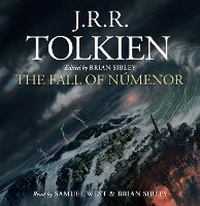
The Fall of Numenor
And Other Tales from the Second Age of Middle-Earth
Published on 16. March 2023
Audio
CD-Audio
978-0-00-853787-6 (ISBN)
Description
J.R.R. Tolkien's writings on the Second Age of Middle-earth, collected for the first time in one volume.
J.R.R. Tolkien famously described the Second Age of Middle-earth as a 'dark age, and not very much of its history is (or need be) told'. And for many years readers would need to be content with the tantalizing glimpses of it found within the pages of The Lord of the Rings and its appendices, including the forging of the Rings of Power, the building of the Barad-dur and the rise of Sauron.
It was not until Christopher Tolkien published The Silmarillion after his father's death that a fuller story could be told. Although much of the book's content concerned the First Age of Middle-earth, there were at its close two key works that revealed the tumultuous events concerning the rise and fall of the island of Numenor. Raised out of the Great Sea and gifted to the Men of Middle-earth as a reward for aiding the angelic Valar and the Elves in the defeat and capture of the Dark Lord Morgoth, the kingdom became a seat of influence and wealth; but as the Numenoreans' power increased, the seed of their downfall would inevitably be sown, culminating in the Last Alliance of Elves and Men.
Even greater insight into the Second Age would be revealed in subsequent publications, first in Unfinished Tales of Numenor and Middle-earth, then expanded upon in Christopher Tolkien's magisterial twelve-volume The History of Middle-earth, in which he presented and discussed a wealth of further tales written by his father, many in draft form.
Now, adhering to the timeline of 'The Tale of Years' in the appendices to The Lord of the Rings, editor Brian Sibley has assembled into one comprehensive volume a new chronicle of the Second Age of Middle-earth, told substantially in the words of J.R.R. Tolkien from the various published texts.
J.R.R. Tolkien famously described the Second Age of Middle-earth as a 'dark age, and not very much of its history is (or need be) told'. And for many years readers would need to be content with the tantalizing glimpses of it found within the pages of The Lord of the Rings and its appendices, including the forging of the Rings of Power, the building of the Barad-dur and the rise of Sauron.
It was not until Christopher Tolkien published The Silmarillion after his father's death that a fuller story could be told. Although much of the book's content concerned the First Age of Middle-earth, there were at its close two key works that revealed the tumultuous events concerning the rise and fall of the island of Numenor. Raised out of the Great Sea and gifted to the Men of Middle-earth as a reward for aiding the angelic Valar and the Elves in the defeat and capture of the Dark Lord Morgoth, the kingdom became a seat of influence and wealth; but as the Numenoreans' power increased, the seed of their downfall would inevitably be sown, culminating in the Last Alliance of Elves and Men.
Even greater insight into the Second Age would be revealed in subsequent publications, first in Unfinished Tales of Numenor and Middle-earth, then expanded upon in Christopher Tolkien's magisterial twelve-volume The History of Middle-earth, in which he presented and discussed a wealth of further tales written by his father, many in draft form.
Now, adhering to the timeline of 'The Tale of Years' in the appendices to The Lord of the Rings, editor Brian Sibley has assembled into one comprehensive volume a new chronicle of the Second Age of Middle-earth, told substantially in the words of J.R.R. Tolkien from the various published texts.
Reviews / Votes
'Physically beautiful and sometimes overwhelming in its power, this book is a grand compendium of all Tolkien said about the period when the foundations of The Lord of the Rings are laid'John Garth, THE GUARDIAN
'It brings a Biblical grandeur to Tolkien's fictional history'
WINTER IS COMING
'A trove of source material about one of Middle-earth's most intriguing and central back stories. The book is beautifully illustrated by Alan Lee and nimbly edited by Brian Sibley'
WASHINGTON POST
'For those wishing to expand their understanding of Middle-earth and the incredible legend crafted by Tolkien, this is an essential piece to complete that puzzle'
BOOK REPORTER
'How, given little over half a century of work, did one man become the creative equivalent of a people?'
THE GUARDIAN
'Demanding to be compared with English mythologies... at times rises to the greatness of true myth'
FINANCIAL TIMES
'A creation of singular beauty... magnificent in its best moments'
WASHINGTON POST
'With this most recent volume, The Fall of Numenor, Sibley has beautifully and brilliantly done for Tolkien's Second Age what Christopher Tolkien did for the First Age'
NATIONAL REVIEW
More details
Edition
Unabridged edition
Language
English
Place of publication
London
United Kingdom
Publishing group
HarperCollins Publishers
Edition type
Unabridged edition
Product notice
Audio CD
Dimensions
Height: 142 mm
Width: 139 mm
Thickness: 25 mm
Duration
Dauer: 640 min
Weight
230 gr
ISBN-13
978-0-00-853787-6 (9780008537876)
Copyright in bibliographic data and cover images is held by Nielsen Book Services Limited or by the publishers or by their respective licensors: all rights reserved.
Schweitzer Classification
Other editions
Additional editions
J.R.R. Tolkien | Brian Sibley
The Fall of Numenor
And Other Tales from the Second Age of Middle-Earth
Book
11/2022
HarperCollins
€93.50
Available immediately
J.R.R. Tolkien | Brian Sibley
The Fall of Numenor
And Other Tales from the Second Age of Middle-Earth
E-Book
11/2022
HarperCollins
€6.89
Available for download
Persons
J.R.R.Tolkien (1892-1973) was a distinguished academic, though he is best known for writing The Hobbit, The Lord of the Rings and The Silmarillion, plus other stories and essays. His books have been translated into over 80 languages and have sold many millions of copies worldwide.