

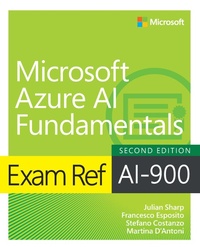
Exam Ref AI-900 Microsoft Azure AI Fundamentals
2. Auflage
Erschienen am 14. Oktober 2025
224 Seiten
978-0-13-541720-1 (ISBN)
Beschreibung

Prepare for Microsoft Exam AI-900 and demonstrate your real-world knowledge of diverse machine learning (ML) and artificial intelligence (AI) concepts, and how they can be implemented with Microsoft Azure services. Designed for business stakeholders, new and existing IT professionals, consultants, and students, this Exam Ref focuses on the critical thinking and decision-making acumen needed for success at the Microsoft Certified: Azure AI Fundamentals level.
Focus on the expertise measured by these objectives:
Describe AI workloads and considerations
Describe fundamental principles of machine learning on Azure
Describe features of computer vision workloads on Azure
Describe features of Natural Language Processing (NLP) workloads on Azure
Describe features of conversational AI workloads on Azure
This Microsoft Exam Ref:
Organizes its coverage by exam objectives
Features strategic, what-if scenarios to challenge you
Assumes you are a business user, stakeholder, technical professional, or student who wants to become familiar with Azure AI; requires no data science or software engineering experience.
Focus on the expertise measured by these objectives:
Describe AI workloads and considerations
Describe fundamental principles of machine learning on Azure
Describe features of computer vision workloads on Azure
Describe features of Natural Language Processing (NLP) workloads on Azure
Describe features of conversational AI workloads on Azure
This Microsoft Exam Ref:
Organizes its coverage by exam objectives
Features strategic, what-if scenarios to challenge you
Assumes you are a business user, stakeholder, technical professional, or student who wants to become familiar with Azure AI; requires no data science or software engineering experience.
Weitere Details
Reihe
Auflage
2nd edition
Sprache
Englisch
Verlagsort
Boston
USA
Verlagsgruppe
Pearson Education (US)
Zielgruppe
Für Beruf und Forschung
Dateigröße
8,49 MB
ISBN-13
978-0-13-541720-1 (9780135417201)
Copyright in bibliographic data and cover images is held by Nielsen Book Services Limited or by the publishers or by their respective licensors: all rights reserved.
Schweitzer Klassifikation
Weitere Ausgaben
Andere Ausgaben
Julian Sharp | Francesco Esposito | Stefano Costanzo
Exam Ref AI-900 Microsoft Azure AI Fundamentals
Buch
ca. 12/2025
2. Auflage
Addison Wesley
46,50 €
Noch nicht erschienen
Personen
JULIAN SHARP is a solutions architect, trainer, and Microsoft Business Applications MVP with over 30 years of experience in IT. He completed his MA in Mathematics at the University of Cambridge. Julian has spoken at Microsoft Ignite and many other community events. For the past 15 years, he has been a Microsoft Certified Trainer delivering certification training around Dynamics 365, Azure, and the Power Platform. He has taught thousands of students with a high pass rate. Julian has a passion for artificial intelligence to enhance user experience and customer data in the solutions that he designs.
FRANCESCO ESPOSITO, armed with a strong mathematical background, is the author of three Microsoft Press books on machine learning. He also founded Youbiquitous, an AI factory mostly working on LLMs and computer vision, and KBMS Data Force, a startup focused on digital therapy and intelligent healthcare. He is also Head of Engineering & Data at Crionet, a company that provides innovative solutions for the sport and media industries.
STEFANO COSTANZO is a computer engineer with a deep passion for artificial intelligence. He completed his Master's degree at Tor Vergata University, where his thesis explored how large language models and information-retrieval techniques can be combined to detect fake news. Stefano approaches AI development with a solution-oriented mindset. He sees artificial intelligence as an innovative tool that can be integrated into various sectors in surprising ways, unlocking new possibilities for creative solutions.
MARTINA D'ANTONI is a software engineer with a background in clinical and biomedical engineering. Since 2021, Martina has worked in the healthcare sector, applying a blend of traditional software development and artificial intelligence to support innovation in medical technologies. Driven by curiosity and a keen interest in both data and language, she approaches problems with precision and analytical rigor. Her passion for continuous learning fuels her commitment to exploring how emerging technologies, particularly AI, can enhance patient care and shape the future of healthcare, as well as how they can more broadly support and integrate with human development.
FRANCESCO ESPOSITO, armed with a strong mathematical background, is the author of three Microsoft Press books on machine learning. He also founded Youbiquitous, an AI factory mostly working on LLMs and computer vision, and KBMS Data Force, a startup focused on digital therapy and intelligent healthcare. He is also Head of Engineering & Data at Crionet, a company that provides innovative solutions for the sport and media industries.
STEFANO COSTANZO is a computer engineer with a deep passion for artificial intelligence. He completed his Master's degree at Tor Vergata University, where his thesis explored how large language models and information-retrieval techniques can be combined to detect fake news. Stefano approaches AI development with a solution-oriented mindset. He sees artificial intelligence as an innovative tool that can be integrated into various sectors in surprising ways, unlocking new possibilities for creative solutions.
MARTINA D'ANTONI is a software engineer with a background in clinical and biomedical engineering. Since 2021, Martina has worked in the healthcare sector, applying a blend of traditional software development and artificial intelligence to support innovation in medical technologies. Driven by curiosity and a keen interest in both data and language, she approaches problems with precision and analytical rigor. Her passion for continuous learning fuels her commitment to exploring how emerging technologies, particularly AI, can enhance patient care and shape the future of healthcare, as well as how they can more broadly support and integrate with human development.
Inhalt
Chapter 1: Describe artificial intelligence workloads and considerations
Chapter 2: Describe fundamental principles of machine learning on Azure
Chapter 3: Describe features of computer vision workloads on Azure
Chapter 4: Describe features of natural language processing (NLP) workloads on Azure
Chapter 5: Describe features of generative AI workloads on Azure
Chapter 6: AI-900 Microsoft Azure AI Fundamentals exam updates
Chapter 2: Describe fundamental principles of machine learning on Azure
Chapter 3: Describe features of computer vision workloads on Azure
Chapter 4: Describe features of natural language processing (NLP) workloads on Azure
Chapter 5: Describe features of generative AI workloads on Azure
Chapter 6: AI-900 Microsoft Azure AI Fundamentals exam updates
