

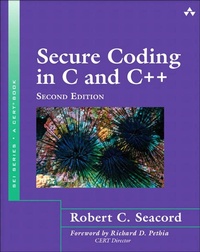
Secure Coding in C and C++
Secure Coding in C and C+_2
2. Auflage
Erschienen am 11. März 2013
600 Seiten
978-0-13-298194-1 (ISBN)
Beschreibung

Learn the Root Causes of Software Vulnerabilities and How to Avoid Them
Commonly exploited software vulnerabilities are usually caused by avoidable software defects. Having analyzed tens of thousands of vulnerability reports since 1988, CERT has determined that a relatively small number of root causes account for most of the vulnerabilities.
Secure Coding in C and C++, Second Edition, identifies and explains these root causes and shows the steps that can be taken to prevent exploitation. Moreover, this book encourages programmers to adopt security best practices and to develop a security mindset that can help protect software from tomorrow's attacks, not just today's. Drawing on the CERT's reports and conclusions, Robert C. Seacord systematically identifies the program errors most likely to lead to security breaches, shows how they can be exploited, reviews the potential consequences, and presents secure alternatives.
Coverage includes technical detail on how to
Improve the overall security of any C or C++ application
Thwart buffer overflows, stack-smashing, and return-oriented programming attacks that exploit insecure string manipulation logic
Avoid vulnerabilities and security flaws resulting from the incorrect use of dynamic memory management functions
Eliminate integer-related problems resulting from signed integer overflows, unsigned integer wrapping, and truncation errors
Perform secure I/O, avoiding file system vulnerabilities
Correctly use formatted output functions without introducing format-string vulnerabilities
Avoid race conditions and other exploitable vulnerabilities while developing concurrent code
The second edition features
Updates for C11 and C++11
Significant revisions to chapters on strings, dynamic memory management, and integer security
A new chapter on concurrency
Access to the online secure coding course offered through Carnegie Mellon's Open Learning Initiative (OLI)
Secure Coding in C and C++, Second Edition, presents hundreds of examples of secure code, insecure code, and exploits, implemented for Windows and Linux. If you're responsible for creating secure C or C++ software-or for keeping it safe-no other book offers you this much detailed, expert assistance.
Commonly exploited software vulnerabilities are usually caused by avoidable software defects. Having analyzed tens of thousands of vulnerability reports since 1988, CERT has determined that a relatively small number of root causes account for most of the vulnerabilities.
Secure Coding in C and C++, Second Edition, identifies and explains these root causes and shows the steps that can be taken to prevent exploitation. Moreover, this book encourages programmers to adopt security best practices and to develop a security mindset that can help protect software from tomorrow's attacks, not just today's. Drawing on the CERT's reports and conclusions, Robert C. Seacord systematically identifies the program errors most likely to lead to security breaches, shows how they can be exploited, reviews the potential consequences, and presents secure alternatives.
Coverage includes technical detail on how to
Improve the overall security of any C or C++ application
Thwart buffer overflows, stack-smashing, and return-oriented programming attacks that exploit insecure string manipulation logic
Avoid vulnerabilities and security flaws resulting from the incorrect use of dynamic memory management functions
Eliminate integer-related problems resulting from signed integer overflows, unsigned integer wrapping, and truncation errors
Perform secure I/O, avoiding file system vulnerabilities
Correctly use formatted output functions without introducing format-string vulnerabilities
Avoid race conditions and other exploitable vulnerabilities while developing concurrent code
The second edition features
Updates for C11 and C++11
Significant revisions to chapters on strings, dynamic memory management, and integer security
A new chapter on concurrency
Access to the online secure coding course offered through Carnegie Mellon's Open Learning Initiative (OLI)
Secure Coding in C and C++, Second Edition, presents hundreds of examples of secure code, insecure code, and exploits, implemented for Windows and Linux. If you're responsible for creating secure C or C++ software-or for keeping it safe-no other book offers you this much detailed, expert assistance.
Weitere Details
Reihe
Auflage
2nd edition
Sprache
Englisch
Verlagsort
Boston
USA
Verlagsgruppe
Pearson Education (US)
Zielgruppe
Für höhere Schule und Studium
Dateigröße
11,17 MB
ISBN-13
978-0-13-298194-1 (9780132981941)
Copyright in bibliographic data and cover images is held by Nielsen Book Services Limited or by the publishers or by their respective licensors: all rights reserved.
Schweitzer Klassifikation
Weitere Ausgaben
Andere Ausgaben
Robert Seacord
Secure Coding in C and C++
Buch
04/2013
2. Auflage
Addison Wesley
59,39 €
Versand in 10-20 Tagen
Person
Robert C. Seacord is currently the Secure Coding Technical Manager in the CERT Program of Carnegie Mellon's Software Engineering Institute (SEI). He is the author or coauthor of five books, including The CERT (R) C Secure Coding Standard (Addison-Wesley, 2009), and is the author and instructor of a video training series, Professional C Programming LiveLessons, Part I: Writing Robust, Secure, Reliable Code (Addison-Wesley, 2013).
Inhalt
Foreword xvii Preface xxi
Acknowledgments xxv
About the Author xxvii
Chapter 1: Running with Scissors 1
1.1 Gauging the Threat 5
1.2 Security Concepts 12
1.3 C and C++ 17
1.4 Development Platforms 25
1.5 Summary 27
1.6 Further Reading 28
Chapter 2: Strings 29
2.1 Character Strings 29
2.2 Common String Manipulation Errors 42
2.3 String Vulnerabilities and Exploits 50
2.4 Mitigation Strategies for Strings 72
2.5 String-Handling Functions 84
2.6 Runtime Protection Strategies 101
2.7 Notable Vulnerabilities 117
2.8 Summary 118
2.9 Further Reading 120
Chapter 3: Pointer Subterfuge 121
3.1 Data Locations 122
3.2 Function Pointers 123
3.3 Object Pointers 124
3.4 Modifying the Instruction Pointer 125
3.5 Global Offset Table 127
3.6 The .dtorsSection 129
3.7 Virtual Pointers 131
3.8 The atexit()and on_exit()Functions 133
3.9 The longjmp()Function 134
3.10 Exception Handling 136
3.11 Mitigation Strategies 139
3.12 Summary 142
3.13 Further Reading 143
Chapter 4: Dynamic Memory Management 145
4.1 C Memory Management 146
4.2 Common C Memory Management Errors 151
4.3 C++ Dynamic Memory Management 162
4.4 Common C++ Memory Management Errors 172
4.5 Memory Managers 180
4.6 Doug Lea's Memory Allocator 182
4.7 Double-Free Vulnerabilities 191
4.8 Mitigation Strategies 212
4.9 Notable Vulnerabilities 222
4.10 Summary 224
Chapter 5: Integer Security 225
5.1 Introduction to Integer Security 225
5.2 Integer Data Types 226
5.3 Integer Conversions 246
5.4 Integer Operations 256
5.5 Integer Vulnerabilities 283
5.6 Mitigation Strategies 288
5.7 Summary 307
Chapter 6: Formatted Output 309
6.1 Variadic Functions 310
6.2 Formatted Output Functions 313
6.3 Exploiting Formatted Output Functions 319
6.4 Stack Randomization 332
6.5 Mitigation Strategies 337
6.6 Notable Vulnerabilities 348
6.7 Summary 349
6.8 Further Reading 351
Chapter 7: Concurrency 353
7.1 Multithreading 354
7.2 Parallelism 355
7.3 Performance Goals 359
7.4 Common Errors 362
7.5 Mitigation Strategies 368
7.6 Mitigation Pitfalls 384
7.7 Notable Vulnerabilities 399
7.8 Summary 401
Chapter 8: File I/O 403
8.1 File I/O Basics 403
8.2 File I/O Interfaces 407
8.3 Access Control 413
8.4 File Identification 432
8.5 Race Conditions 450
8.6 Mitigation Strategies 461
8.7 Summary 472
Chapter 9: Recommended Practices 473
9.1 The Security Development Lifecycle 474
9.2 Security Training 480
9.3 Requirements 481
9.4 Design 486
9.5 Implementation 503
9.6 Verification 512
9.7 Summary 518
9.8 Further Reading 518
References 519
Acronyms 539
Index 545
Acknowledgments xxv
About the Author xxvii
Chapter 1: Running with Scissors 1
1.1 Gauging the Threat 5
1.2 Security Concepts 12
1.3 C and C++ 17
1.4 Development Platforms 25
1.5 Summary 27
1.6 Further Reading 28
Chapter 2: Strings 29
2.1 Character Strings 29
2.2 Common String Manipulation Errors 42
2.3 String Vulnerabilities and Exploits 50
2.4 Mitigation Strategies for Strings 72
2.5 String-Handling Functions 84
2.6 Runtime Protection Strategies 101
2.7 Notable Vulnerabilities 117
2.8 Summary 118
2.9 Further Reading 120
Chapter 3: Pointer Subterfuge 121
3.1 Data Locations 122
3.2 Function Pointers 123
3.3 Object Pointers 124
3.4 Modifying the Instruction Pointer 125
3.5 Global Offset Table 127
3.6 The .dtorsSection 129
3.7 Virtual Pointers 131
3.8 The atexit()and on_exit()Functions 133
3.9 The longjmp()Function 134
3.10 Exception Handling 136
3.11 Mitigation Strategies 139
3.12 Summary 142
3.13 Further Reading 143
Chapter 4: Dynamic Memory Management 145
4.1 C Memory Management 146
4.2 Common C Memory Management Errors 151
4.3 C++ Dynamic Memory Management 162
4.4 Common C++ Memory Management Errors 172
4.5 Memory Managers 180
4.6 Doug Lea's Memory Allocator 182
4.7 Double-Free Vulnerabilities 191
4.8 Mitigation Strategies 212
4.9 Notable Vulnerabilities 222
4.10 Summary 224
Chapter 5: Integer Security 225
5.1 Introduction to Integer Security 225
5.2 Integer Data Types 226
5.3 Integer Conversions 246
5.4 Integer Operations 256
5.5 Integer Vulnerabilities 283
5.6 Mitigation Strategies 288
5.7 Summary 307
Chapter 6: Formatted Output 309
6.1 Variadic Functions 310
6.2 Formatted Output Functions 313
6.3 Exploiting Formatted Output Functions 319
6.4 Stack Randomization 332
6.5 Mitigation Strategies 337
6.6 Notable Vulnerabilities 348
6.7 Summary 349
6.8 Further Reading 351
Chapter 7: Concurrency 353
7.1 Multithreading 354
7.2 Parallelism 355
7.3 Performance Goals 359
7.4 Common Errors 362
7.5 Mitigation Strategies 368
7.6 Mitigation Pitfalls 384
7.7 Notable Vulnerabilities 399
7.8 Summary 401
Chapter 8: File I/O 403
8.1 File I/O Basics 403
8.2 File I/O Interfaces 407
8.3 Access Control 413
8.4 File Identification 432
8.5 Race Conditions 450
8.6 Mitigation Strategies 461
8.7 Summary 472
Chapter 9: Recommended Practices 473
9.1 The Security Development Lifecycle 474
9.2 Security Training 480
9.3 Requirements 481
9.4 Design 486
9.5 Implementation 503
9.6 Verification 512
9.7 Summary 518
9.8 Further Reading 518
References 519
Acronyms 539
Index 545
