

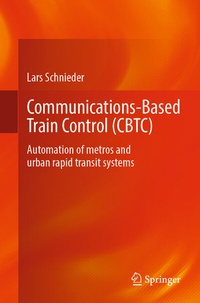
Communications-Based Train Control (CBTC)
Beschreibung

Urban rail systems are increasingly reaching their limits as traffic demand rises. The safety and performance of these transport systems are significantly determined by the control and safety technology used. Expanding the transport offering requires efficient signaling systems, known as Communications-Based Train Control (CBTC) systems. In this book, the author presents the system environment into which CBTC systems are integrated within urban transport companies. It shows how the individual safety functions of CBTC solutions contribute to hazard control and how technical systems progressively take over more functions from humans with increasing grades of automation. Finally, non-functional requirements for CBTC systems such as safety, availability, performance, and cost-effectiveness are discussed, and factors for the successful execution of complex signaling renewal projects are highlighted.
Weitere Details
Weitere Ausgaben
Nachauflagen
Andere Ausgaben
Person
Prof. Dr.-Ing. habil. Lars Schnieder is the CEO of a software development company. He teaches in the field of automated urban transportation systems in the English-language study program "Railway Systems Engineering" at RWTH Aachen University. His teaching at TU Braunschweig focuses on the planning and operation of public transport systems.
Inhalt
Background and Motivation.- System components and surrounding systems of automatic train control systems.- Grades of Automation of Automatic Train Control Systems,- Operating modes and operating mode transitions in automated operations.- Main functions of automatic train control systems.- Dependability of Automatic Train Control Systems.- Balancing costs and benefits of automatic train control systems.- Migration, testing and commissioning of automatic train control systems.- Perspectives and future challenges.
