

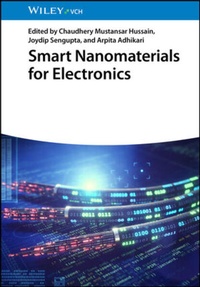
Smart Nanomaterials for Electronics
1. Auflage
Erschienen am 10. März 2026
480 Seiten
978-3-527-81746-7 (ISBN)
Beschreibung

Discover more powerful and versatile electronic devices beyond just silicon!
Nanotechnology has become the central focal point for much of the development of the latest, extremely reliable electronics. In particular, the bottom-up and top-down approaches for the creation of functional nanostructures have demonstrated that they are ideally suited for a broad scope of applications in fields such as flexible electronics, supercapacitors, tissue engineering, solar cells, and chemical sensors. With such a wide range of potential uses, nanomaterials appear to be the wave of the future.
Smart Nanomaterials for Electronics offers a comprehensive look at state-of-the-art research and development in the field of applications of smart nanostructures in electronics. Interdisciplinary research is vital to the success of this growing field, and this book facilitates the diffusion of this type of enquiry in the interrelated and rapidly converging fields of nanoelectronics. The book has a central focus on enhancing the performance of electronic devices using smart nanostructures with special attention given to nanobioelectronics and, more generally, on the approaches that seriously consider the economics and commercialization challenges inherent in the technology. The text also examines the ethical, legal, and social issues presented by nanoelectronics in detail.
Smart Nanomaterials for Electronics readers will also find:
* A review of the latest technology breakthroughs in the application of nanostructures to electronics, with a focus on carbon materials
* A view of smart nanomaterials from the lab to the real world that facilitates the steps from proof-of concept devices to larger-scale production
* Discussion of the chances and challenges of commercialization of nanostructure-based electronic devices
Smart Nanomaterials for Electronics is a useful reference for materials scientists, electrical engineers, solid state physicists, semiconductor physicists, and the libraries that support them all.
Nanotechnology has become the central focal point for much of the development of the latest, extremely reliable electronics. In particular, the bottom-up and top-down approaches for the creation of functional nanostructures have demonstrated that they are ideally suited for a broad scope of applications in fields such as flexible electronics, supercapacitors, tissue engineering, solar cells, and chemical sensors. With such a wide range of potential uses, nanomaterials appear to be the wave of the future.
Smart Nanomaterials for Electronics offers a comprehensive look at state-of-the-art research and development in the field of applications of smart nanostructures in electronics. Interdisciplinary research is vital to the success of this growing field, and this book facilitates the diffusion of this type of enquiry in the interrelated and rapidly converging fields of nanoelectronics. The book has a central focus on enhancing the performance of electronic devices using smart nanostructures with special attention given to nanobioelectronics and, more generally, on the approaches that seriously consider the economics and commercialization challenges inherent in the technology. The text also examines the ethical, legal, and social issues presented by nanoelectronics in detail.
Smart Nanomaterials for Electronics readers will also find:
* A review of the latest technology breakthroughs in the application of nanostructures to electronics, with a focus on carbon materials
* A view of smart nanomaterials from the lab to the real world that facilitates the steps from proof-of concept devices to larger-scale production
* Discussion of the chances and challenges of commercialization of nanostructure-based electronic devices
Smart Nanomaterials for Electronics is a useful reference for materials scientists, electrical engineers, solid state physicists, semiconductor physicists, and the libraries that support them all.
Weitere Details
Weitere Ausgaben
Andere Ausgaben
Chaudhery Mustansar Hussain | Joydip Sengupta | Arpita Adhikari
Smart Nanomaterials for Electronics
Buch
ca. 06/2026
1. Auflage
Wiley-VCH
169,00 €
Noch nicht erschienen
Chaudhery Mustansar Hussain | Joydip Sengupta
Smart Nanomaterials for Electronics
Software
ca. 08/2023
Wiley-VCH
206,43 €
Noch nicht erschienen
Personen
Chaudhery Mustansar Hussain is adjunct professor, academic advisor and lab director at the New Jersey Institute of Technology (NJIT), Newark, New Jersey, USA. His research is focused on the applications of nanotechnology in the environment and in electronics. Dr. Hussain is the author of numerous papers in peer-reviewed journals as well as a prolific author and editor of scientific monographs and handbooks.
Joydip Sengupta is assistant professor in the Department of Electronic Science of the Jogesh Chandra Chaudhuri College, affiliated to University of Calcutta, India. His research is focused on nanotechnology-based methods for the fabrication and characterization of devices based on carbon nanotubes, zinc oxides and silicon carbides.
Arpita Adhikari received her M.Sc. degree in electronic science and the M.Tech. and Ph.D. (Tech.) degrees in radio physics and electronics from the University of Calcutta, Kolkata, India, in 2005, 2007, and 2014, respectively. She has authored or coauthored 14 peer reviewed journal papers. Her current research interests include rain classification, rain microstructure study, rain-induced propagation characteristics, satellite communication and atmospheric techniques.
Joydip Sengupta is assistant professor in the Department of Electronic Science of the Jogesh Chandra Chaudhuri College, affiliated to University of Calcutta, India. His research is focused on nanotechnology-based methods for the fabrication and characterization of devices based on carbon nanotubes, zinc oxides and silicon carbides.
Arpita Adhikari received her M.Sc. degree in electronic science and the M.Tech. and Ph.D. (Tech.) degrees in radio physics and electronics from the University of Calcutta, Kolkata, India, in 2005, 2007, and 2014, respectively. She has authored or coauthored 14 peer reviewed journal papers. Her current research interests include rain classification, rain microstructure study, rain-induced propagation characteristics, satellite communication and atmospheric techniques.
Inhalt
Introduction: Perspectives of Smart Nanostructures
Fundamental Concepts of Electronics
Approaches to Nanoelectronics: Top-Down and Bottom-Up
Carbon Nanostructures and Nanoelectronics
Nanoelectronic Devices
Nanoelectronics with Graphene: Graphene in Batteries, Graphene Electrodes for Touch Screens, Transparent Memory with Graphene, Integrated Circuits with Graphene Transistors
Nanobioelectronics
Nanoelectronics and Smart Sensors
Economics and Commercialization of Nanoelectronics
Ethical, Legal and Social Issues of Nanoelectronics
Future of Nanoelectronics
Conclusions
Fundamental Concepts of Electronics
Approaches to Nanoelectronics: Top-Down and Bottom-Up
Carbon Nanostructures and Nanoelectronics
Nanoelectronic Devices
Nanoelectronics with Graphene: Graphene in Batteries, Graphene Electrodes for Touch Screens, Transparent Memory with Graphene, Integrated Circuits with Graphene Transistors
Nanobioelectronics
Nanoelectronics and Smart Sensors
Economics and Commercialization of Nanoelectronics
Ethical, Legal and Social Issues of Nanoelectronics
Future of Nanoelectronics
Conclusions
