

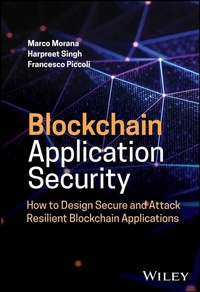
Blockchain Application Security
Beschreibung

Learn to secure, design, implement, and test tomorrow's blockchain applications.
Blockchain Application Security guides readers through the architecture and components of blockchain, including protocols such as Bitcoin and beyond, by offering a technical yet accessible introduction. This resource is ideal for application architects, software developers, security auditors, and vulnerability testers working on enterprise blockchain solutions. It bridges the gap between theory and implementation, providing actionable guidance on protecting decentralized systems while capitalizing on their innovative benefits.
Blockchain Application Security covers the essentials, from the fundamentals of distributed ledgers, consensus algorithms, digital wallets, smart contracts, privacy controls, and DIDs, to designing secure dApp architectures with component-level threat analysis and resilient APIs, token transactions, digital exchanges, and identity models. It features a complete lifecycle example for securing a DeFi lending and borrowing platform, along with practical walkthroughs for smart contract development, AWS-integrated blockchain systems, frontend/API integration, and code auditing.
"An accessible, comprehensive blockchain overview that emphasizes its value across industrial and government sectors with a holistic security focus." -David W. Kravitz, Technical Advisor, Spring Labs
"A cutting-edge method for securing blockchain applications, pushing the boundaries of current practice." -David Cervigni, Senior Security Research Engineer at R3
"Bridging theory and practice with realistic examples, this guide empowers architects and developers to build attack-resistant applications." -Steven Wierckx, Product Security Team Lead & Threatmodel Trainer at Toreon
"A valuable resource for blockchain specialists, featuring hands-on examples of deploying dApps on AWS and securing infrastructure." -Ihor Sasovets, Lead Security Engineer, Penetration Tester at TechMagic
"A practical roadmap for navigating blockchain security that we recommend to clients and incorporate into our training." -Vijay Dhanasekaran, Founder & Chief Blockchain Officer, Consultant at Blocknetics
"An indispensable resource for dApp developers, guiding readers from fundamentals to advanced implementation with in-depth vulnerability analysis." -Mohd Mehdi, Head of DevOps, DevSecOps and Infrastructure at InfStones
Weitere Details
Weitere Ausgaben
Andere Ausgaben
Personen
Marco Morana is the Field CISO at Avocado Systems Inc., where he leads the deployment of runtime threat modeling and product security solutions for enterprise clients where he leads the deployment of runtime threat modeling and product security solutions for enterprise clients. Previously, he held senior security leadership roles at JPMorgan Chase and Citibank, where he directed global architecture programs and led S-SDLC adoption across cloud and application platforms. At Citibank, Marco conducted architecture risk assessments for blockchain pilots including the first digital asset trade with Nasdaq via Chain.com and authored the bank's first security standards for blockchain. He is the coauthor of the PASTA threat modeling methodology and OWASP project leader focused on secure-by-design for blockchain and AI systems.
Harpreet Singh is a seasoned engineering leader with 19 years of experience driving innovation in AI/LLM, cybersecurity, and large-scale distributed systems. He is known for a strategic approach to architecture, a focus on customer trust and safety, and a collaborative leadership style. He has successfully launched new products, integrated emerging technologies, and optimized security practices across global organizations.
Francesco Piccoli is the cofounder and CEO of Almanax, a cybersecurity firm specializing in AI-powered solutions. He was previously the Head of Product at AnChain.AI, where he built security and compliance tools for the US SEC, IRS, and Salesforce. His team was part of $100M+ crypto hacks investigations. Prior to AnChain.AI, he led research initiatives in anomaly detection and autonomous driving. Francesco holds a Master of Engineering from UC Berkeley and lives in New York.
Inhalt
Foreword xiii
Preface xiv
Acknowledgments xviii
Introduction xx
1 The Blockchain Technology Primer 1
1.1 Introduction 1
1.2 Brief History of the Blockchain and Its Evolution 2
1.3 DLT and the Blockchain 2
1.4 Blockchain Networks 7
1.4.1 Nodes 11
1.4.2 Scalability Components 13
1.4.3 Interoperability Components 17
1.4.4 Platforms 19
1.4.5 dApps 22
1.4.6 Practical Examples 23
1.5 The Blockchain Data Structure 26
1.5.1 Hash Functions 28
1.5.2 Digital Signatures 31
1.5.3 Block Structure 36
1.5.4 Merkle Trees 40
1.5.5 Fundamental Blockchain Elements 42
1.5.6 Inherent Security Risks of Blockchain Technology 46
1.6 Consensus Algorithms 55
1.6.1 Different Types of Consensus Algorithms 55
1.6.2 Deterministic Versus Nondeterministic Consensus Algorithms 61
1.7 Cryptocurrencies 64
1.7.1 Cryptocurrencies Use Cases 68
1.7.2 Use of Cryptocurrencies and Security Risks 69
1.8 Digital Wallets 71
1.8.1 Introduction 71
1.8.2 Security Features of Digital Wallets 76
1.9 Digital Transactions 79
1.9.1 Transaction Automation with Smart Contracts 85
1.9.2 Token Transactions 88
1.10 Privacy Controls 90
1.10.1 Anonymity Versus Pseudonymity of Blockchain Transactions 93
1.10.2 Techniques for Enhancing Transaction Privacy 94
1.11 Identity Controls 97
1.11.1 Identity Verification Methods 98
1.11.2 Privacy-Preserving Identities 101
1.11.3 Identity and Access Management 103
1.11.4 Decentralized Identities (DIDs) 105
1.12 Legal and Regulatory Considerations 106
1.13 Conclusions 116
1.14 Future Directions and Trends in Blockchain Technology 117
2 Designing Secure Decentralized Applications 121
2.1 Introduction 121
2.2 Decentralized Applications 127
2.2.1 dApp Architectures 132
2.2.2 Comparison of dApps with Traditional Centralized Applications 139
2.2.3 Analysis of Use Cases for Blockchain and dApps 141
2.3 Security Requirements 145
2.3.1 Elicitation of Security Requirements 145
2.3.2 Example of dApps Security Requirements 149
2.4 Securing dApps 152
2.4.1 Principles of Secure Blockchain Platform Design 153
2.4.1.1 Overview of Security Architecture Principles 154
2.4.1.2 Security Architecture Principles for dApps Design 154
2.4.2 Securing dApps by Design 162
2.4.2.1 Identifying dApps Security Design Flaws and Vulnerabilities 163
2.4.2.2 Securing dApps Components by Design and Implementation 171
2.4.3 Blockchain APIs 185
2.4.3.1 Securing Blockchain APIs 186
2.4.3.2 Blockchain API Vulnerabilities 190
2.4.3.3 Security Review of Blockchain API 193
2.4.4 Securing dApps Confidential Data and Transactions 195
2.4.4.1 Security Requirements for the Protection of Confidential Data 199
2.4.4.2 Vulnerabilities Exposing Confidential and Transactions Data 202
2.4.4.3 Security Reviews to Identify Design Flaws and Vulnerabilities 204
2.4.5 Consensus Algorithms 206
2.4.5.1 Identifying Consensus Algorithm Vulnerabilities 207
2.4.5.2 Secure Consensus Algorithm Best Practices 211
2.4.6 Protecting Secrets 213
2.4.6.1 Practical Examples of Security by Design Protection of Secrets and Keys in dApps 214
2.4.6.2 Identification of Potential Vulnerabilities Related to Secret and Key Management with dApps 217
2.4.7 Securing Token-Based Transactions 218
2.4.7.1 Explanation of Token-Based Transactions 219
2.4.7.2 Secure Token Standards 221
2.4.7.3 Security Considerations for Securing dApps with Token-Based Use Cases 224
2.4.8 Securing Cryptocurrency DEX Transactions 227
2.4.8.1 Securing dApp Integration with Digital Exchanges 228
2.4.8.2 Mitigating the Risks of DEX Use Cases 233
2.4.9 Securing Digital Identities (DIDs) 234
2.4.9.1 Explanation of Digital Identities 242
2.4.9.2 Security Considerations for Digital Identities 245
2.4.10 Securing Smart Contracts 248
2.4.10.1 Overview of Smart Contracts and Security Considerations 248
2.4.10.2 Common Smart Contract Vulnerabilities and Associated Risks 251
2.4.10.3 Best Practices for Smart Contracts Security 255
2.5 Conclusions for This Chapter 266
2.5.1 Future Trends in Blockchain Technology and Security 267
3 Mitigating Blockchain Vulnerabilities 269
3.1 Introduction 269
3.1.1 Focused dApp Application Security 270
3.1.2 dApp Vulnerabilities Risks 272
3.1.3 Security Incidents: Lessons Learned for Future Resilience 273
3.1.3.1 Smart Contract Exploits: Confronting a Critical Threat 274
3.1.3.2 Digital Wallet Design Flaws: Mitigating Emerging Threats 278
3.1.3.3 Proactive Security Recommendations from Blockchain Breaches 280
3.2 Enhancing Blockchain Security: Mitigating Vulnerabilities and Design Flaws 286
3.2.1 Introduction to Threat Modeling 288
3.2.2 PASTA Threat Modeling 292
3.2.2.1 Definition of Business Objectives 293
3.2.2.2 Definition of the Technical Scope 295
3.2.2.3 Application Decomposition and Analysis 297
3.2.2.4 Threat Analysis 299
3.2.2.5 Vulnerability Analysis 301
3.2.2.6 Attack Modeling (AM) 304
3.2.2.7 Risk Assessment and Mitigation 307
3.2.3 Threat Modeling Example: DeFi Lending and Borrowing dApp 311
3.2.3.1 Stage 0 - Setting the Stages for PASTA Threat Modeling 317
3.2.3.2 Stage I - Definition of Business Objectives 318
3.2.3.3 Stage II - Definition of Technical Scope 337
3.2.3.4 Stage III - Application Decomposition and Analysis 345
3.2.3.5 Stage IV - Threat Analysis 362
3.2.3.6 Stage V - Vulnerability Analysis 381
3.2.3.7 Stage VI - Attack Modeling 399
3.2.3.8 Stage VII - Risk Analysis and Management 418
3.2.4 Security-Driven Tools and Techniques for dApps 443
3.3 Auditing Blockchain Applications for Compliance 452
3.4 Conclusions 458
4 Securing Blockchain Applications: Practical Examples 461
4.1 Introduction 461
4.2 dApp Creation Example 462
4.2.1 Architecture 462
4.2.2 Project Components 462
4.2.2.1 Token.sol (ERC-20 Token Contract) 462
4.2.2.2 Smart Contract Deployment 463
4.2.3 AWS Integration 464
4.2.3.1 API Gateway Setup 464
4.2.3.2 Create a New API in Amazon API Gateway 464
4.2.3.3 Link the API to AWS Lambda Function 464
4.2.3.4 Define API Methods 465
4.2.3.5 Additional Configuration 466
4.2.4 Create a Frontend 466
4.2.4.1 Create React App 467
4.2.4.2 Create Frontend Code 467
4.2.5 Security Review 468
4.2.5.1 Smart Contract Vulnerabilities 468
4.2.5.2 AWS Lambda Security 468
4.2.5.3 API Gateway Misconfigurations 469
4.2.5.4 Data Storage Risks 469
4.2.5.5 Blockchain Event Handling 470
4.2.5.6 Cross-Origin Resource Sharing (CORS) 470
4.2.5.7 Frontend Integration Risks 470
4.2.6 Conclusion 470
4.3 Code Auditing Examples 471
4.3.1 Introduction 471
4.3.2 Rationale for Secure Coding Practices 471
4.3.3 Auditing Smart Contract Code 472
4.3.3.1 Common Smart Contract Vulnerabilities: Reentrancy 473
4.3.3.2 Integer Overflows and Underflows 474
4.3.3.3 DoS of Smart Contracts 474
4.3.3.4 Access Control Failures 475
4.3.3.5 Logic Flaws and Business Logic Errors 476
4.3.4 Audit Processes and Tools for Smart Contracts 476
4.3.4.1 Manual Code Review 476
4.3.4.2 Automated Static Analysis Tools 477
4.3.4.3 Unit and Integration Testing 477
4.3.4.4 Formal Verification 478
4.3.5 Best Practices in Smart Contract Audits 478
4.3.5.1 Security by Design 478
4.3.5.2 Remediation and Secure Redeployment 479
4.3.6 Auditing Blockchain Node Software 479
4.3.6.1 Types of Blockchain Nodes 479
4.3.6.2 Typical Vulnerabilities in Node Implementations 480
4.3.6.3 Approaches to Node Software Auditing 483
4.3.7 Auditing Wallet Software 484
4.3.7.1 Types of Wallets 485
4.3.7.2 Wallet-Specific Vulnerabilities 486
4.3.7.3 Wallet Security Audits and Testing 488
4.3.8 Auditing dApps 489
4.3.8.1 dApp Architecture Components 489
4.3.8.2 Common dApp Vulnerabilities 490
4.3.8.3 dApp Auditing and Testing 491
4.3.9 Consolidating Findings and Reporting 492
4.3.9.1 Security Reporting Framework 493
4.3.9.2 Coordination with Development Teams (see the note) 494
4.3.9.3 Disclosure Best Practices 494
4.3.10 Conclusion 495
Appendix A: Threat Modeling Matrix 497
Appendix B: Mapping of Threat Scenarios to Targeted Weaknesses and Asset Impacted 531
Appendix C: Mapping of Threat Scenarios to Exploitable Attack Paths 541
Appendix D: Threat Scenarios Attack Simulation Tests 543
Appendix E: Threat Scenario Weakness and Vulnerabilities Risk Ratings 547
Appendix F: Risks Mitigation Plan 553
Appendix G: Threats Risk Register 557
Appendix H: Attack Simulation Testing Report 559
Appendix I: Risk Analysis Report 563
References 571
About the Authors 591
Index 593
Preface
Blockchain technology has evolved significantly over the past decade, reshaping the way we think about trust, security, and decentralization. I wrote this book to share the lessons I have learned from my early experiments with blockchain security, dating back to 2015. At the time, I was a Senior Application Security Architect at one of the largest financial institutions in the United States, where I was responsible for conducting security reviews of blockchain-based projects. These initiatives were undertaken in collaboration with start-ups developing blockchain technology and banking consortia exploring its potential applications.
With any emerging technology comes both innovation and risk. While blockchain has introduced new capabilities that disrupt traditional business processes, it also presents novel security challenges that organizations must navigate to ensure safe and effective adoption. One of the primary concerns remains the integration of blockchain with legacy systems, a complex but necessary requirement for broader enterprise adoption. Despite the growing enthusiasm around blockchain, real-world implementations must undergo rigorous security assessments to address vulnerabilities and operational risks.
Like all digital innovations, blockchain is not immune to security threats. A well-known example from its early days was the 2016 DAO attack, where a decentralized autonomous organization built on Ethereum was exploited due to multiple security flaws, resulting in a loss of approximately $50 million. This incident highlighted the critical need for proactive security measures in blockchain development, particularly for decentralized applications (dApps) and smart contracts.
In the early stages of private and permissioned blockchains, security assessments were often limited to checklist-based reviews, lacking the depth required to address blockchain-specific risks. The absence of standardized methodologies made it difficult to conduct architecture risk analysis and threat modeling, leaving significant gaps in security assurance. Over time, I observed the growing need for structured security frameworks to guide the secure design, development, and deployment of blockchain applications.
Fast forward to today, blockchain technology has transitioned from being an experimental innovation in financial services to becoming a mainstream platform for Web3.0 applications, including decentralized finance (DeFi), supply chain solutions, and digital identity management. The ecosystem has matured, equipping developers with advanced tools and frameworks to build dApps that integrate with blockchain platforms efficiently. However, this progress has also expanded the attack surface, making security a paramount concern.
This book began as a project in 2018 with the goal of educating readers about the fundamentals of blockchain technology, its use cases, and security considerations for private and permissioned enterprise-grade blockchain platforms. Over time, the scope broadened to address the security challenges of dApps, offering insights into how developers, security professionals, and business leaders can design, build, and secure blockchain-based solutions.
Who Should Read This Book?
This book is designed for stakeholders managing the security risks of dApps and blockchain-based products. Whether you are an architect, engineer, security leader, or business executive, this book provides insights tailored to your role:
- Security architects will gain a comprehensive understanding of designing secure dApps from the ground up. They will learn how to embed security into architecture, design patterns, and APIs, ensuring blockchain applications are resilient against attacks.
- Software security engineers will find practical guidance on securing dApp implementations, identifying vulnerabilities, and testing blockchain applications for security flaws. This book also covers threat modeling, DevSecOps integration, and secure coding practices for smart contracts.
- CISOs and product security business owners will benefit from governance, compliance, and risk management perspectives. This book provides strategies for security oversight, ensuring compliance with regulatory standards and best practices for blockchain security assurance.
How to Navigate This Book?
Should this book be read from beginning to end? That depends on the reader. While the chapters build upon one another, making sequential reading beneficial especially for those new to blockchain security, the content is structured to allow readers to focus on topics most relevant to their roles.
For security architects, Chapter 2 is the core section, covering dApp architectures, security requirements, and security by design principles. This chapter provides a detailed breakdown of securing APIs, protecting secrets, and implementing secure smart contracts. Chapter 3 is also essential, as it provides a comprehensive approach to securing blockchain applications by focusing on vulnerability prevention, threat modeling, and security testing. It introduces structured methodologies to identify, analyze, and mitigate risks in dApps, particularly within DeFi ecosystems. One of the key highlights of this chapter is the dApp DeFi threat modeling use case, providing a practical, step-by-step guide for security architects and engineers. It outlines how to identify attack vectors, assess design flaws, and implement risk mitigation strategies early in development. This structured approach ensures dApps are secure by design, implementation, and testing, rather than addressing security issues postdeployment. Chapter 4 offers practical insights on dApp creation, auditing methodologies, and security implementation strategies.
For software security engineers, the primary focus should be on Chapter 2, which covers API security, key management, and smart contract security best practices. This chapter provides essential insights into securing dApp components, ensuring that authentication, data protection, and cryptographic key handling are implemented securely. Chapter 3 offers an in-depth exploration of smart contract vulnerabilities, detailing common attack vectors such as reentrancy, integer overflows, and logic flaws. It also introduces threat modeling methodologies, helping engineers systematically identify and mitigate risks before deployment. Additionally, this chapter discusses DevSecOps security tooling, highlighting automated vulnerability scanning, continuous security integration, and security validation techniques that can be embedded into the development pipeline.
Chapter 4 is particularly valuable, offering hands-on guidance on smart contract audits, security testing methodologies, and practical implementation strategies. It provides real-world examples of securing dApps, focusing on code auditing, penetration testing, and best practices for secure deployment. This chapter also covers attack simulation exercises, allowing engineers to test security assumptions and refine their defenses against emerging threats in blockchain applications.
For CISOs and heads of product security, Chapter 1 is critical as it establishes the legal, regulatory, and risk considerations associated with blockchain applications. This chapter explores the compliance landscape, including data privacy laws, financial regulations, and jurisdictional challenges, helping organizations align blockchain adoption with corporate risk management strategies.
Chapter 3 is indispensable, providing a deep dive into security incidents, compliance audits, and risk management methodologies for dApps and blockchain platforms. It covers real-world case studies of blockchain security breaches, analyzing attack techniques, lessons learned, and strategic mitigation measures. Additionally, this chapter outlines frameworks for security audits, industry compliance standards, and enterprise-wide blockchain security governance. The risk assessment methodologies presented here help prioritize threats, implement proactive defenses, and establish incident response strategies tailored to blockchain ecosystems.
While Chapter 4 is primarily technical, it is still relevant for CISOs and heads of product security who need a high-level understanding of secure code audits. This chapter provides insights into what security code reviews should focus on, key risk areas in blockchain applications, and the types of vulnerabilities auditors typically uncover. It helps security leaders evaluate and oversee secure coding practices, ensuring that blockchain development teams implement proper security controls.
The appendices, including the Risk Analysis Report, the Risk Mitigation Plan, and the Threat Risk Register, provide examples to support informed, risk-based decisions for managing dApp DeFI technical and business risks. These resources help document security measures, establish risk mitigation strategies, and ensure compliance with regulatory requirements.
By leveraging these chapters, CISOs and heads of product security can build a structured approach to blockchain security governance, compliance oversight, and risk management, while gaining a better understanding of secure code auditing processes.
Final Thoughts
Blockchain technology continues to evolve and disrupt multiple industries, but its success depends on how well we secure and manage its risks. The intent of this book is to provide actionable guidance, real-world examples, and best practices for securing blockchain applications - whether they are enterprise-grade permissioned platforms or dApps in Web3 and DeFi.
As security professionals, engineers,...
