

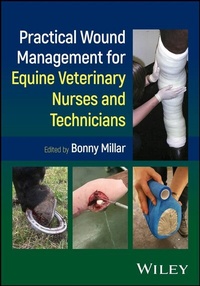
Practical Wound Management for Equine Veterinary Nurses and Technicians
Beschreibung

Presents a step-by-step guide to equine wound care for veterinary nurses and technicians
Practical Wound Management for Equine Veterinary Nurses and Technicians is a highly accessible and comprehensive resource tailored specifically to the needs of equine practice. Recognising that wound management requires both clinical expertise and practical problem-solving, this clear and reliable manual focuses on the unique responsibilities of nursing professionals, guiding readers through every stage of wound care, from initial assessment and safe patient restraint to advanced surgical nursing and aftercare.
Edited by Bonny Millar, the range of expert contributions integrates foundational principles with the latest developments in moist wound healing, infection control, and dressing selection, while also providing clear instructions on bandaging techniques, monitoring, care plans, ethical considerations, and managing complications. A wealth of high-quality colour photographs and practical tips help readers apply treatment techniques to daily practice.
This reference also:
- Covers wound types, dressing and bandaging, healing processes, and complications
- Emphasises effective client communication and aftercare advice
- Guides readers on safe patient handling and restraint during treatment
- Provides details on surgical and medical management options and factors that delay wound healing
- Contains concise explanations designed for quick reference in clinics
Practical Wound Management for Equine Veterinary Nurses and Technicians is an essential resource for equine veterinary nurses and technicians in both routine and critical situations. It will also be valuable to students of veterinary nursing and veterinary medicine courses, graduate and advanced levels, and diploma and degree-level programs that focus on equine care or surgery.
Weitere Details
Weitere Ausgaben
Andere Ausgaben
Person
Bonny Millar, RVN, REVN, CVT(USA), is an equine veterinary nurse with extensive experience in referral and university hospital environments in both the USA and UK. She is a former Head Nurse at Rossdales Equine Hospital, UK and was the first equine veterinary nurse to be appointed President of the British Veterinary Nursing Association. Her professional interests include wound management, critical care, neonatology, and advancing standards in equine nursing care.
Inhalt
List of Contributors xiv
Foreword by Tim Greet xv
Foreword by Deborah Reeder xvi
Preface xvii
Acknowledgments xviii
1 The Wound Healing Process 1
Georgie Hollis and Bonny Millar
2 Understanding Wound Types 8
Derek Knottenbelt
3 Factors That Delay Wound Healing 24
Derek Knottenbelt
4 First Aid for Wounds and Emergency Veterinary Treatment 42
Claire Robinson
5 Wound Assessment, Investigation and Diagnosis 57
Sarah Baillie
6 Surgical Management and Treatment Methods 71
Claire Robinson
7 Dressings and Wound Preparations 97
Bonny Millar
8 Bandaging Techniques and Materials 126
Bonny Millar
9 Nutrition for Optimal Wound Healing 152
Clare MacLeod
10 Pain Management in Equine Wound Care 161
Catriona MacKenzie and Bonny Millar
11 Equine Nursing Care Plans and Wound Care Bundles 170
Bonny Millar
12 Ethical Wound Management and Animal Welfare 182
Sarah Baillie
13 Wound Management for Underserved Equid Populations in the Resource-Limited Setting 191
Patrick J. Pollock
Conclusion 200
References 200
Index 201
1
The Wound Healing Process
Georgie Hollis1,2 and Bonny Millar3,4
1Founder of Bandaging Angels and Gray's Anatomical Ltd., Garboldisham, Norfolk, UK
2Chief Commercial Officer, Aluco Health, Diss, Suffolk, UK
3Registered (Equine) Veterinary Nurse Consultant, Gwynedd, North Wales, UK
4Emergency Services Call Handler, Equicomms, CVS Group plc, Diss, Norfolk, UK
The skin is the body's largest organ, primarily serving to protect the underlying tissues and organs from injury. It consists of two layers: the epidermis and the dermis. The outermost epidermal layer forms a physical, waterproof barrier against invading pathogenic microorganisms, harmful chemicals and foreign bodies. When the skin is broken, localised repair processes respond to the injury and initiate healing. In horses, traumatic skin wounds are common and often require extensive wound management. This presents a significant welfare concern and places a considerable financial burden on the global equine industry (Theoret and Schumacher 2017, p. 1). Similarly, a survey of horse owners in the United Kingdom revealed that certain management practices increased the risk of traumatic injuries and related wounds (Owen et al. 2012).
When an open wound is left untreated, as happens with animals in the wild, it naturally begins to heal. What follows is a remarkable sequence of continuous and well-defined phases that influence each other, occurring at the correct times and for the appropriate durations, aiming to close the wound and restore the area to good functioning health. Disruptions and prolonged adverse conditions that affect this process can cause delays in wound healing.
Wound Healing Physiology
The objectives of wound management are to
- achieve a functional and cosmetic outcome,
- minimise pain and distress,
- promote a rapid return to normal use,
- deliver healing at a reasonable cost (Knottenbelt 2003; Owen and Wenke 2007).
Wound healing is a complex but predictable sequence of biological events that begins at the moment of injury and concludes with the remodelling and maturation of new tissue. In horses, this process is notably influenced by the wound's location, size and the relative mobility and vascularity of surrounding tissue.
Healing by second intention - when wounds are allowed to heal naturally without surgical closure - is common in equine practice. The time required for full resolution depends mainly on the capacity for wound contraction and epithelialisation. This process is influenced by local factors such as skin elasticity and regional blood supply. Wounds on the upper body or trunk, where there is greater skin laxity and vascular support, tend to contract substantially during healing. In contrast, wounds on the distal limbs typically contract to a lesser degree because of tight, immobile skin and limited subcutaneous tissue (Theoret and Schumacher 2017, p. 34).
These regional differences in healing capacity partly explain why distal limb wounds are considered particularly challenging. Adding to this is the equine species' relatively inefficient inflammatory response, which predisposes horses to wound chronicity and the formation of exuberant granulation tissue (Wilmink and van Weeren 2005).
A sound understanding of each stage of the wound healing process - along with their expected timelines - allows clinicians to intervene appropriately, manage expectations and optimise outcomes. While second intention healing is biologically remarkable, early, well-timed surgical reconstruction (e.g. primary closure or grafting) often results in a more cosmetic and functional result in less time and can ultimately be more cost-effective.
While financial constraints frequently lead to the use of dressings and bandages alone, this 'cheaper' option may become more costly if healing is delayed. In many cases, early interventions such as pinch grafting can significantly accelerate healing and reduce the risk of complications.
All complications and delays in healing stem from disruptions in the healing cascade. Understanding the typical sequence and timing of tissue repair provides a baseline for clinical decision-making and timely intervention.
Phases of Wound Healing
Wound healing occurs in overlapping phases: haemostasis and inflammation occur first, followed by tissue proliferation and contraction and then long-term collagen remodelling (Figure 1.1). Understanding this process helps guide the timing of wound management measures.
Haemostasis (Immediate - Minutes Post-injury)
Within minutes of injury, vasoconstriction reduces blood loss. Platelets adhere to exposed subendothelial collagen, forming a temporary plug. Platelet activation initiates a cascade of cytokine and chemokine release, triggering the early inflammatory response. The platelets release a variety of bioactive molecules, which attract neutrophils and macrophages to the wound site. Simultaneously, fibrinogen is converted to fibrin, stabilising the clot. Clot formation typically occurs within 10-15 minutes unless major vessels are involved.
Figure 1.1 The wound healing cascade.
Source: Reproduced with permission of Georgie Hollis.
Inflammation (Hours to ~4 Days Post-injury)
The inflammatory phase begins within hours and peaks around 48 hours post-injury. Vasodilation increases vascular permeability, allowing neutrophils to infiltrate within 6-12 hours. These cells neutralise bacteria and start clearing contaminants. Macrophages arrive later to phagocytose dead tissue and pathogens, and release proteases that prepare the wound for the next phase. Although wounds in this phase may appear sloughy or malodorous, these signs do not necessarily mean infection - they reflect critical immune activity.
Bacterial contamination occurs immediately and can progress to colonisation, critical colonisation and then infection if not addressed early. Human guidelines suggest that when bacterial numbers exceed 105/g, healing will be delayed and infection may follow as bacteria proliferate further (Bowler 2003) (Figure 1.2). Decontamination within the first 6 hours is essential to prevent local or systemic infection.
Effective management during this phase includes
- Copious and early lavage with tissue-compatible solutions improves the ability to remove bacteria before they establish deeper colonisation. For every hour earlier a wound is lavaged, the rate of bacterial proliferation is halved (Owen and Wenke 2007).
- Sharp, mechanical or autolytic debridement.
- Use of topical agents to soften devitalised tissue.
Figure 1.2 The development of infection over time.
Source: Reproduced with permission of Georgie Hollis.
Prolonged inflammation often results from an inhibitor such as persistent necrotic tissue, exposure of bone or tendon, foreign bodies or excessive movement at the wound site (see Chapter 3, Factors that Delay Wound Healing). These factors prolong macrophage activity and protease release, hindering progression to proliferation.
Proliferation (Approximately Days 4-21 Post-injury)
Angiogenesis
Fibroblasts migrate into the wound within days of injury and begin to lay down layers of collagen to form a matrix for new capillary buds to grow into. This tissue is fragile, and when damaged by movement and repeated trauma, it stimulates macrophage activity that can revert the wound back to the inflammatory phase. This is why maintaining a moist environment to support optimal cell proliferation, minimising interference and immobilising wounds over joints is recommended during this phase.
As granulation tissue fills the wound bed, fibroblasts begin differentiating into myofibroblasts, which possess contractile properties that enable wound contraction. This may begin as early as 7 days post-injury but becomes most evident around 10-14 days once a healthy granulating wound bed has formed and the first signs of an epithelial margin appear.
Epithelialisation occurs concurrently with granulation. Basal epithelial cells from wound edges and adnexal structures, such as hair follicles, begin migrating over the granulation tissue within 4-5 days post-injury. It is a slow process, with keratinocytes progressing centripetally at approximately 1-1.5 mm every 10 days under ideal conditions, but this may take longer on the equine limb (Knottenbelt 2003).
Maturation/Remodelling (3 Weeks to Months or Longer)
Once the wound bed is covered with epithelium and contraction is largely complete, the wound enters the remodelling phase. During proliferation, type III collagen is deposited in a haphazard manner. Remodelling can take up to 2 years, by which time collagen levels do not increase, but the existing fibres have rearranged into a more organised structure (Theoret and Schumacher 2017, p. 10). The wound has minimal tensile strength until type III collagen is gradually replaced by type I collagen,...
