

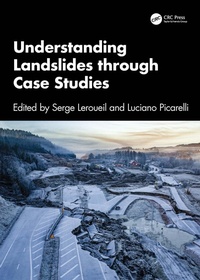
Understanding Landslides through Case Studies
1. Auflage
Erschienen am 14. April 2026
480 Seiten
978-1-135-03694-2 (ISBN)
Beschreibung

Landslides are a major geohazard and a threat to communities and infrastructure worldwide. As climate change effects intensify, a good understanding of the triggering factors and slope instability mechanisms is vital in order to assess and mitigate the risk. This comprehensive guide delves into slope failure and post-failure landslide mechanisms - knowledge that can save lives and protect communities globally.
Structured in two complementary parts, this authoritative volume first builds a solid theoretical foundation before bringing concepts to life through several well documented examples. Part I explores the fundamental soil properties with specific concern to slopes, uncovers the often-complex mechanisms of slope failure and examines the crucial individual factors that control slope movements. This section hence provides the essential theoretical framework for understanding these destructive natural phenomena. Part II reports 28 well-documented case histories presented by renowned experts from all over the world. These compelling case studies, which illuminate typical and less common phenomena of slope deformation and failure, transform abstract concepts into practical insights.
Whether you're a researcher pushing the boundaries of geotechnical knowledge, a practitioner implementing slope stability solutions, or a graduate student in soil engineering or geohazards, this book delivers invaluable knowledge directly applicable to your work. Civil engineers and geologists will also find this accessible volume an essential addition to their professional library.
Structured in two complementary parts, this authoritative volume first builds a solid theoretical foundation before bringing concepts to life through several well documented examples. Part I explores the fundamental soil properties with specific concern to slopes, uncovers the often-complex mechanisms of slope failure and examines the crucial individual factors that control slope movements. This section hence provides the essential theoretical framework for understanding these destructive natural phenomena. Part II reports 28 well-documented case histories presented by renowned experts from all over the world. These compelling case studies, which illuminate typical and less common phenomena of slope deformation and failure, transform abstract concepts into practical insights.
Whether you're a researcher pushing the boundaries of geotechnical knowledge, a practitioner implementing slope stability solutions, or a graduate student in soil engineering or geohazards, this book delivers invaluable knowledge directly applicable to your work. Civil engineers and geologists will also find this accessible volume an essential addition to their professional library.
Weitere Details
Auflage
1. Auflage
Sprache
Englisch
Verlagsort
London
Großbritannien
Verlagsgruppe
Taylor & Francis Ltd
Zielgruppe
Für höhere Schule und Studium
Für Beruf und Forschung
Illustrationen
43 Tables, black and white; 555 Line drawings, black and white; 141 Halftones, black and white; 696 Illustrations, black and white
Dateigröße
234,26 MB
ISBN-13
978-1-135-03694-2 (9781135036942)
Copyright in bibliographic data and cover images is held by Nielsen Book Services Limited or by the publishers or by their respective licensors: all rights reserved.
Schweitzer Klassifikation
Weitere Ausgaben
Andere Ausgaben
Serge Leroueil | Luciano Picarelli
Understanding Landslides through Case Studies
Buch
ca. 04/2026
1. Auflage
CRC Press
210,50 €
Noch nicht erschienen
Personen
Serge Leroueil is Emeritus Professor at the Civil Engineering Department of Universite Laval, Quebec, Canada and an expert on landslide mechanisms. His research interests include soil behaviour, soil viscosity, soil compaction, in-situ testing, embankments on soft clays, and cuts and natural slopes. Serge gave the Rankine Lecture upon the invitation of the British Geotechnical Society on the theme of landslides and is Fellow of the Academy of Science of the Royal Society of Canada; he has moreover received several prestigious awards like the Legget Medal and the Canadian Senate Medal.
Luciano Picarelli is former professor at the Civil Engineering Department of the Seconda Universita di Napoli where he was Director of the Research Center in Environmental Engineering. For twelve years, Luciano chaired the Joint Technical Committee (JTC1) on Landslides set up by the Federation of International Geo-engineering Societies (FedIGS). Luciano's research focuses on the mechanics of structurally complex formations, geotechnical issues in road construction, and slope stability and landslide risk mitigation. Throughout his academic life, Luciano has given numerous lectures all over the world, including the Suklje and the Croce Lectures. Finally, he received the Varnes medal bestowed by the International Consortium on Landslides.
Luciano Picarelli is former professor at the Civil Engineering Department of the Seconda Universita di Napoli where he was Director of the Research Center in Environmental Engineering. For twelve years, Luciano chaired the Joint Technical Committee (JTC1) on Landslides set up by the Federation of International Geo-engineering Societies (FedIGS). Luciano's research focuses on the mechanics of structurally complex formations, geotechnical issues in road construction, and slope stability and landslide risk mitigation. Throughout his academic life, Luciano has given numerous lectures all over the world, including the Suklje and the Croce Lectures. Finally, he received the Varnes medal bestowed by the International Consortium on Landslides.
Inhalt
Part 1: From Soil Mechanics to Slope Mechanics 1. Slope formation in a geotechnical perspective 2. Slope movements 3. Behaviour and properties of soils in the context of slopes 4. Slope movements induced by changes in boundary stress conditions 5. Slope movements induced by changes in hydraulic or physico-thermo-chemical conditions 6. From pre-failure to post-failure (including reactivation) Part 2: Case studies 7. Hydro-mechanical pre-failure processes 8. First-time landslides 9. Active and reactivated landslides 10. Flow-like landslides in cohesive soils 11. Flow-like landslides in cohesionless soils 12. Spreads
