

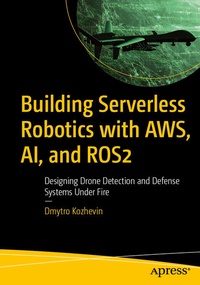
Building Serverless Robotics with AWS, AI, and ROS 2
Beschreibung

This book takes a hands-on, simplified approach to building scalable robotic systems using Terraform for infrastructure and Python for logic. This book eliminates unnecessary complexity, offering practical techniques such as storing binary data in Amazon S3 to trigger AI-based workflows-allowing you to move swiftly from prototype to production.
In this book, you'll learn how to set up a ROS2-based camera with servo motors, process images using AI models hosted on AWS, and trigger automated actions with Lambda functions and DynamoDB. Each chapter walks you through real-world implementations, providing Terraform code for deploying serverless components. You'll discover how to manage data streams, run AI-powered object detection, and send movement commands to ROS2 devices-all while maintaining a fully integrated cloud-robotics workflow. Rather than isolating cloud and robotics concepts, this book presents a practical, end-to-end approach with code snippets and best practices for seamless deployment.
By the end of this book, you'll have a repeatable framework for using AWS services and AI agents to control and manage ROS2 devices-without the need for complex IoT setups. Whether you're a robotics enthusiast or a cloud developer, you'll gain the confidence to build scalable, cost-effective, real-time robotics applications that respond to real-world events effortlessly.
What you will learn:
- How to set up a simplified serverless pipeline using AWS, Terraform, and Python
- Explore integrating ROS2 devices with AI agents for real-time event handling
- How to deploy AI-driven object detection and servo control logic
- How to manage data flows efficiently with minimal overhead
Who this book is for:
DevOps engineers, robotics enthusiasts, and AI/ML practitioners . Developers looking to integrate ROS2 devices with cloud services. Software architects seeking practical serverless solutions
Weitere Details
Weitere Ausgaben
Andere Ausgaben
Person
Dmytro Kozhevin is an accomplished DevOps Engineer and Educator with over 18 years of experience, specializing in AI, serverless robotics, and cloud infrastructure. Currently, he focuses on AWS EKS, CI/CD, and Kubernetes, helping professionals implement scalable, automated solutions. His expertise extends to integrating AI-driven workflows with AWS services and ROS2, enabling real-time decision-making in robotics. Passionate about innovation, Dmytro is dedicated to simplifying complex DevOps and AI challenges, making advanced cloud and automation technologies accessible through education, hands-on training, and real-world applications.
Inhalt
Chapter 1: Serverless Robotics Under Fire: Core Concepts.- Chapter 2: Build the Lab Before the Battle Begins.- Chapter 3 - Forging the Device Inventory.- Chapter 4: Event Processing Machinery.- Chapter 5: WebSocket Device Connection.- Chapter 6: Presigned URLs for Large File Uploads.- Chapter 7: Protobuf Deep Dive - From Simple to Production-Grade.- Chapter 8: AI Audio Processing - Detecting Drones from Sound.- Chapter 9: Edge Computing - Why the Jetson Changes Everything.- Chapter 10: Thermal Tracking with Kalman Prediction.- Chapter 11: Spotlight Control - Illuminating Predicted Positions.- Chapter 12: Multi-Sensor Fusion - When the Network Becomes the Sensor.- Chapter 13: Multi-Sensor Fusion - Triangulation & Tracking.- Chapter 14: Command & Control Dashboard - Making Chaos Visible.- Chapter 15: Edge ML Optimization - Squeezing Blood from Silicon.- Chapter 16: Operational Monitoring - Seeing Through the Fog of War.- Chapter 17: Testing Strategies - From Unit to Field.- Chapter 18: Fleet Management & OTA Updates - Herding Cats with Code.- Chapter 19: Security Hardening - When the Hunters Become the Hunted.- Chapter 20: Scaling to Thousands - When Your Success Becomes Your Problem.- Chapter 21: The Ghost in the Machine - Building an Intelligent Agent.- Chapter 22: Advanced Computer Vision - When Good Enough Isn't.- Chapter 23: Swarm Intelligence - When One Brain Isn't Enough.- Chapter 24: Lessons from the Field - Where Theory Meets Thunder.- Appendix A: Complete Terraform Module Reference.- Appendix B: Protobuf Message Catalog.- Appendix C: Glossary of Terms.
