

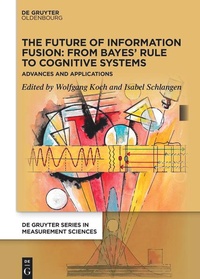
The Future of Information Fusion
Beschreibung

"Intelligence" is an omnipresent phenomenon in the biosphere. In the technosphere, artificially intelligent signal processing and sensor data fusion provide cognitive sensors that enhance the perceptive mind of humans who alone perceive consciously. This book thus opens up AI-enabled sensing, which comprises not only machine or deep learning, but exploits a whole world of algorithms for comprehensively sensing in real applications.
Weitere Details
Weitere Ausgaben
Andere Ausgaben
Personen
Prof. Dr. Wolfgang Koch, Fellow IEEE
Chief Scientist Fraunhofer FKIE and
Head of Dept. "Sensor Data and Information Fusion"
Wolfgang Koch earned his PhD in theoretical physics at the RWTH Aachen and his habilitation in computer science at the University of Bonn. There he teaches signal processing, sensor data fusion, AI, and resources management ("apl. Prof."). In these fields, he has published a monograph and numerous technical papers. As Chief Scientist of Fraunhofer FKIE and head of a research department, he is driving digitalization in defence, aerospace, and public security. For the national technology development of the "Future Combat Air System" (FCAS), he coordinates the defence-related Fraunhofer Institutes. He is particularly interested in ethical, social, and legal aspects of digitization, which he investigates as co-chair of the working group Technology Responsibility for FCAS. As a Fellow of the IEEE and an IEEE Distinguished Lecturer, Koch is member of Board of Governors of the IEEE Aerospace and Electronic Systems Society (AESS). As a member of the Board of Directors of the International Information Fusion Society (ISIF) and the SET Panel of NATO STO, he contributes to defence technology research at the international level.
Monography
Tracking and Sensor Data Fusion. Methodological Framework and Selected Applications. Springer Nature, Mathematical Engineering Series, Berlin/Heidelberg 2014, ISBN 978-3-642-39270-2
Editorship
With Richard Klemm, Hugh Griffiths (Hrsg.): Novel Radar Techniques and Applications. Part II: Target Tracking and Data Fusion. SciTech Publishing, 2017, ISBN 978-1-61353-226-3
Handbook Chapters
Accumulated State Densities and Their Applications in Object Tracking. Chapter 18 in: H. Fourati (Ed.). Multisensor Data Fusion: From Algorithm and Architecture Design to Applications. CRC Press 2016, ISBN 978-0-367-65628-7.
The Role of Context in Multiple Sensor Systems for Civil Security. Chapter 20 in: L. Snidaro et al. (Eds.). Context Enhanced Information Fusion. Springer Nature, Berlin/Heidelberg 2016, ISBN 978-3-319-28971-7
Zur Ethik der wehrtechnischen Digitalisierung. Informations- und ingenieurwissenschaftliche Aspekte. Kapitel 1 in: M. Rogg et al. (Hrsg.). Ethische Herausforderungen digitalen Wandels in bewaffneten Konflikten. German Institute for Defence (GIDS), Hamburg 2020, ISBN 978-3-948752-00-2
