

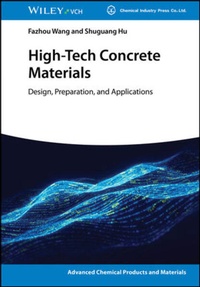
High-Tech Concrete Materials
Beschreibung

Concrete materials research has entered a transformative era, where technological innovation and advanced material science converge to redefine structural and functional performance. High-Tech Concrete Materials: Design, Preparation, and Applications addresses the pressing need for a systematic framework that integrates high-performance concrete design with cutting-edge preparation methods and sustainable application strategies.
In-depth chapters cover a wide spectrum of innovations, including the microstructural optimization of ultra-high-strength concretes, the durability preservation of ultra-high-performance concretes, composite structural concretes applied in mega-infrastructure projects, and pioneering methods such as CO2-driven 3D printing concrete. Richly supported with case studies, patents, and engineering applications, the book highlights how academic insights translate into real-world performance.
High-Tech Concrete Materials: Design, Preparation, and Applications:
* Provides thorough coverage of raw material design, structural performance enhancement, and sustainability strategies
* Features detailed discussion of innovative admixtures, polymers, nano-seeding technologies, and fiber reinforcement mechanisms
* Offers insight into microstructural optimization and durability preservation for ultra-high-strength and ultra-high-performance concretes
* Establishes an approach that emphasizes multifunctional, eco-sustainable concrete systems for future development
Designed to provide readers with both conceptual clarity and practical guidance, High-Tech Concrete Materials: Design, Preparation, and Applications is ideal for advanced undergraduate and graduate courses in Materials Science, Civil Engineering, Construction Engineering, and Inorganic Chemistry, particularly within degree programs focused on structural materials and sustainable infrastructure. It is also a vital reference for researchers, materials scientists, and industry professionals engaged in high-performance concrete design and application.
Weitere Details
Weitere Ausgaben
Andere Ausgaben
Personen
Fazhou Wang is Professor of Materials Science at Wuhan University of Technology. He is currently the Director of the State Key Laboratory of Silicate Materials for Architectures. He has been engaged in the academic research and engineering application of high-performance cement-based materials. He has received many scientific awards, including two National Science and Technology Progress Awards (2nd place), and six provincial and ministerial Science and Technology Progress Awards (1st place). He is the editors for many professional journals and serves in many academic organizations.
Inhalt
Chapter 1 Introduction
1.1 Overview
1.2 Brief History of Advanced Technology Concrete Development
1.3 Challenges and Opportunities for Concrete Materials
1.4 Technical Characteristics and Research Content of Advanced Technology Concrete
Chapter 2 Cementitious Material for Advanced Technology Concrete
2.1 Characteristics of Advanced Technology Concrete
2.2 Types of Cementitious Materials for Advanced Technology Concrete
2.3 Mechanism and Properties of Cementitious Materials for Advanced Technology Concrete
2.4 Prospects for Design and Development of Composite Cementitious Materials
Chapter 3 Functional Materials for Advanced Technology Concrete
3.1 Concrete Admixtures
3.2 Polymer Materials
3.3 Fiber Material
3.4 Ultra Fine Powder
3.5 Nano Seeds
3.6 Internal Curing Functional Materials
3.7 Functional Aggregates
Chapter 4 Ultra-high Strength Concrete
4.1 Macro Defect Free Cement
4.2 Densified System Containing Homogenously Arranged Ultra-fine Particles
4.3 Compact Reinforced Composite
4.4 Reactive Particle Concrete
4.5 Reinforcement Mechanism of Ultra-high Strength Cementitious Composite
Chapter 5 Ultra-high Performance Concrete
5.1 Overview of Ultra-high Performance Concrete
5.2 Design of Ultra-high Performance Concrete
5.3 Physical and Mechanical Properties of Ultra-high Performance Concrete (UHPC)
5.4 Volumetric Stability of Ultra-high Performance Concrete
5.5 Durability Properties of Ultra-high Performance Concrete
5.6 Novel Ultra-high Performance Concrete
5.7 Application of Ultra-high Performance Concrete for Municipal Solid Waste Pre-treatment Plants
Chapter 6 High Performance Composite Structural Concrete
6.1 Concrete-filled Steel Tubes Combination Material
6.2 Steel-concrete/asphalt Composite Bridge Deck Paving Structural Materials
6.3 Composite Materials for Structural/Functional Tunnel Concrete
6.4 High Strength Lightweight Aggregate Concrete
Chapter 7 Novel Functional Concrete Technologies
7.1 Recyclable Cement and Concrete
7.2 Resin Aggregate Concrete
7.3 CO2-driven 3D Printing Concrete
1
Introduction
1.1 Overview
Concrete is the most widely used man-made material and a primary building material in the world today, playing an irreplaceable role. Compared to other common building materials such as metals and organic materials, concrete has low production energy consumption, wide availability of raw materials, simple preparation processes, and consequently low production costs. At the same time, it possesses characteristics such as durability, fire resistance, strong adaptability to engineering and the environment, and convenient application [1, 2].
Concrete technology has evolved from the early use of primitive natural cementing materials to the contemporary use of artificially produced cementing materials. The material composition has progressed from a simple triad of cementitious materials, aggregates (ranging from coarse to fine), and water to a diverse system with various additives and functional admixtures. The material performance design has advanced from basic single mechanical strength to a combination of ultra-high strength, high durability and functionality. The preparation technology has developed from the simplest hand mixing to the application of various advanced technologies and intelligent methods. In short, today's concrete has comprehensively entered a new stage known as high-tech concrete [3-6].
High-tech concrete refers to concrete prepared based on ordinary concrete technology using advanced material science theories and innovative manufacturing technologies. This ensures the prepared concrete exhibits superior material properties, excellent functionality, and unique, environmentally friendly characteristics. It effectively expands the application scope of traditional concrete, giving it a stronger vitality. The categorization of high-tech concrete includes high-strength concrete (HSC), high-performance concrete (HPC), ultra-high-strength concrete (UHSC), and ultra-high-performance concrete (UHPC), as well as special composite concrete.
The development of high-tech concrete began in the mid-20th century, accompanying the progress of modern society, large-scale infrastructure construction, and the expansion of human living spaces, leading to new and higher requirements for building materials. It also relies on the rapid development of science and technology in other fields, possessing a strong logical connection to the era. During this period, concrete experts worldwide actively participated in the technological innovation wave, seizing opportunities, actively exploring, and making continuous breakthroughs in various aspects of concrete, from strength and various performance metrics to raw materials and preparation methods, as well as the application of concrete materials, products, and engineering. This has continuously elevated the foundational and critical role of concrete in social development to a new and higher level. Today, we can see various iconic modern concrete projects everywhere: super-long, super-deep, and super-large underwater tunnels; various types of large-span bridges; massive underground structures; towering skyscrapers; transportation networks crossing mountains and rivers; ocean engineering in swift waves and harsh extreme environments; and special major projects. All of these contributions are attributed to high-tech concrete.
Undoubtedly, this is a proud era in the history of concrete development. However, it is also precisely because of the unprecedented activity in technological thinking and the freedom and breadth of research work that concrete has never experienced such a flourishing of technological achievements. This often leads to disputes over technical concepts and evaluation systems, affecting the overall efficiency of research work. The reasons for this are, on the one hand, the broader and more independent thinking of contemporary scientists, who are more innovative. On the other hand, this is influenced by the widespread introduction of advanced theories and technologies from other disciplines, resulting in more research methods and technical approaches. Additionally, due to the development of information technology, people are increasingly accustomed to rapid learning through online information, lacking the important research atmosphere of conferences, effective deliberation, and consensus formation. We should view this rationally and dialectically. It is a sign of social progress, broadening our horizons, quickly borrowing from advanced theories and methods, helping researchers effectively break free from traditional constraints, improving research efficiency and level, and promoting greater progress in the scientific and technological aspects of this discipline. Of course, at the same time, we should also pay attention to new problems, strengthen academic exchanges and collaborative research on common issues, share achievements, avoid detours, and advance the overall research level and scientific and technological achievements in this discipline.
1.2 Brief History of High-tech Concrete Development
1.2.1 Ordinary Concrete
The technical characteristics of ordinary concrete are a relatively simple material composition, a higher water-cement ratio (W/C), and the use of a relatively straightforward mixing and preparation technique. The compressive strength of concrete is generally less than 50 MPa. Ordinary concrete includes plain concrete and ordinary reinforced concrete.
1.2.1.1 Plain Concrete
Plain concrete refers to concrete that does not add any other supplementary components in addition to the three basic components of concrete: cement, aggregate and water. Modern Portland (silicate) cement, the world's first patented cement invented by British construction worker Joseph Aspdin in 1824, marked the beginning of modern cement, and the cost was low, especially with lower energy consumption. The advent of this hydraulic cementitious material endowed concrete with the needed strength and durability. Its raw materials were easily available. Consequently, it significantly expanded the application scope of concrete, establishing its indispensable position in construction materials. The technical characteristics of plain concrete involve using only the three basic ingredients and simple mixing and forming processes, resulting in a compressive strength generally ranging from 20 to 30 MPa after hardening.
For over a century, concrete technology has undergone continuous development and exploration. However, there have been no fundamental breakthroughs in the main performance strength during this time. In 1896, French scientist Feret first proposed a strength formula based on pore content. In 1919, American scientist Duff Abrams found through numerous experiments that there was a correlation between the water-cement ratio (W/C) and concrete strength, indicating an inverse relationship between concrete strength and W/C. In 1930, Swiss scientist Belomey studied and proposed the famous relationship formula between concrete strength, actual cement strength, and W/C under certain conditions, demonstrating that reducing the amount of water could enhance concrete strength. In the 1960s, American researcher T. C. Powers conducted more in-depth research, considering the main hydration product of cement (gel) and establishing the well-known T. C. Powers model. He proposed the relationship formula between strength and gel-to-void ratio, indicating the impact of capillary pore volume on strength. The basic conclusion of these research results is that a lower W/C can reduce the volume of voids (pores) in concrete materials, leading to a higher strength. However, for ordinary concrete, to meet the preparation process and ensure the workability of fresh concrete mixtures, it is necessary to add water significantly higher than the complete hydration of cement. Therefore, it is challenging to significantly improve the strength of concrete, and a higher W/C also makes the material structure relatively loose, affecting other properties of concrete [7].
1.2.1.2 Ordinary Reinforced Concrete
To improve the strength and enhance the performance of concrete, researchers began to experiment with introducing additional raw materials or improving the concrete preparation methods based on plain concrete. The goal was to achieve concrete with better strength and performance. These efforts paved the way for the development of modern concrete technology. A milestone achievement in this journey occurred in 1849 when French landscape architect Joseph Monier invented the original reinforced concrete, thereby enhancing the stability and durability of concrete structures. In 1879, Austrian Hatschek produced asbestos fiber concrete, marking the era of fiber-reinforced concrete and achieving breakthroughs in the crack resistance of concrete products. In 1910, H. F. Porter from the United States obtained a patent for steel fiber-reinforced concrete, improving the strength and overall performance of concrete. In 1928, Freyssinet from France created prestressed reinforced concrete. In 1934, the United States invented the concrete vibrator, effectively compacting and uniformizing concrete during the forming process, thereby enhancing its strength and impermeability. In 1937, E. W. Scxiptrit from the United States researched and patented the world's first water reducer, Pozzolitn, providing a technological approach to improving concrete strength by reducing the water-cement ratio (W/C). At the end of the 19th century and the beginning of the 20th century, polymers appeared in concrete, and it was discovered that the...
