

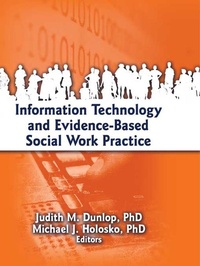
Information Technology and Evidence-Based Social Work Practice
Erschienen am 13. Mai 2013
252 Seiten
978-1-136-45155-3 (ISBN)
Beschreibung

Learn to use the latest technological advances in evidence-based social work
Social work practice can be positively or negatively impacted by the advance of technology. Advances and applications must be up-to-date as possible, yet they may be ineffective if not simple enough to easily learn and use. InformationTechnology and Evidence-Based Social Work presents leading social work experts exploring the latest technological advances and the innovative practical applications which can be used effectively in evidence-based social work. Students and practitioners get creative practical advice on how best understand technology and apply it to their work.
Information Technology and Evidence-Based Social Work is divided into four sections. The first section provides the context for understanding the technological link between social work and evidence-based practice. The second section presents examples of how information technology can be used to effectively teach students and practitioners in the field. Section three explores ways to implement technology for use by clients. The fourth section summarizes and then takes a look at the future of technology in evidence-based social work. Chapters include questions for practitioners and for clients to illuminate the current and future issues surrounding technology and evidence-based practice. The text also includes extensive references, and useful tables and figures.
Topics in Information Technology and Evidence-Based Social Work include:
the impact of technology on social work
computer-assisted evidence-based practice
customized web-based technology and its use in clinical supervision
enhanced technology-based evidence-based practice model and its applicability to large human service organizations.
using information technology to provide evidence for planning and evaluating programs
using technology in advocacy
the geographic information system (GIS) as a useful tool in all aspects of programs and policies
evaluating practice through information technology
the development and evaluation of an online social work service
psychotherapeutic group intervention for family caregivers over the Internet
support group online chat
a case study of how Internet chat group technology can be implemented with cancer survivors
technology as a service learning mechanism for promoting positive youth development in a community-based setting
a model which can be used to collect information and-by using best evidence available-arrive at a confident decision
and more!
Information Technology and Evidence-Based Social Work is timely, stimulating reading for educators, undergraduate students, graduate students, and practitioners in the fields of social work, psychology, and public administration.
Social work practice can be positively or negatively impacted by the advance of technology. Advances and applications must be up-to-date as possible, yet they may be ineffective if not simple enough to easily learn and use. InformationTechnology and Evidence-Based Social Work presents leading social work experts exploring the latest technological advances and the innovative practical applications which can be used effectively in evidence-based social work. Students and practitioners get creative practical advice on how best understand technology and apply it to their work.
Information Technology and Evidence-Based Social Work is divided into four sections. The first section provides the context for understanding the technological link between social work and evidence-based practice. The second section presents examples of how information technology can be used to effectively teach students and practitioners in the field. Section three explores ways to implement technology for use by clients. The fourth section summarizes and then takes a look at the future of technology in evidence-based social work. Chapters include questions for practitioners and for clients to illuminate the current and future issues surrounding technology and evidence-based practice. The text also includes extensive references, and useful tables and figures.
Topics in Information Technology and Evidence-Based Social Work include:
the impact of technology on social work
computer-assisted evidence-based practice
customized web-based technology and its use in clinical supervision
enhanced technology-based evidence-based practice model and its applicability to large human service organizations.
using information technology to provide evidence for planning and evaluating programs
using technology in advocacy
the geographic information system (GIS) as a useful tool in all aspects of programs and policies
evaluating practice through information technology
the development and evaluation of an online social work service
psychotherapeutic group intervention for family caregivers over the Internet
support group online chat
a case study of how Internet chat group technology can be implemented with cancer survivors
technology as a service learning mechanism for promoting positive youth development in a community-based setting
a model which can be used to collect information and-by using best evidence available-arrive at a confident decision
and more!
Information Technology and Evidence-Based Social Work is timely, stimulating reading for educators, undergraduate students, graduate students, and practitioners in the fields of social work, psychology, and public administration.
Weitere Details
Sprache
Englisch
Verlagsort
London
Großbritannien
Verlagsgruppe
Taylor & Francis Ltd
Zielgruppe
Für höhere Schule und Studium
Produkt-Hinweis
Reflowable
Dateigröße
3,42 MB
ISBN-13
978-1-136-45155-3 (9781136451553)
Copyright in bibliographic data and cover images is held by Nielsen Book Services Limited or by the publishers or by their respective licensors: all rights reserved.
Schweitzer Klassifikation
Weitere Ausgaben
Andere Ausgaben
Judith Dunlop | Michael J. Holosko
Information Technology and Evidence-Based Social Work Practice
Buch
01/2007
1. Auflage
Routledge
282,13 €
Versand in 10-20 Tagen
Judith Dunlop | Michael J. Holosko
Information Technology and Evidence-Based Social Work Practice
Buch
01/2007
Routledge
96,71 €
Versand in 10-20 Tagen
Personen
Dunlop, Judith; Holosko, Michael J.
Inhalt
Introduction (Judith M. Dunlop and Michael J. Holosko)
SECTION I: TECHNOLOGY AND EVIDENCE-BASED PRACTICE
Information Technology and Social WorkThe Dark Side or Light Side? (Rick Csiernik, Patricia Furze, Laura Dromgole, and Giselle Marie Rishchynski)
Is Computer-Assisted EBP Generating Fast Practice? (Larry W. Kreuger, John J. Stretch, and Michael J. Kelly)
The SATOL Project: An Interdisciplinary Model of Technology Transfer for Research-to-Practice in Clinical Supervision for Addiction Treatment (Shulamith Lala Ashenberg Straussner, Madeline A. Naegle, Colleen Gillespie, Eileen Wolkstein, Robin Donath, and Efrain C. Azmitia)
A Technology Enhanced EBP Model (Dick Schoech, Randy Basham, and John Fluke)
Using Information Technology in Planning Program Evaluation (Donald R. Leslie, Michael J. Holosko, and Judith M. Dunlop)
Building Evidence-Based Advocacy in Cyberspace: A Social Work Imperative for the New Millennium (John G. McNutt)
SECTION II: EDUCATIONAL IMPLICATIONS
Geographic Information Systems: Potential Uses in Social Work Education and Practice (Thomas P. Felke)
Producing Your Won Evidence for Evidence Based Practice (Shinaz G. Jindani and Claudia P. Newman)
Evidence from Virtual Social Work Practice: Implications for Education (Julia Waldman and Jackie Rafferty)
SECTION III: IMPLEMENTING EVIDENCE BASED TECHNOLOGY FOR CLIENTS
Developing Evidence for an Internet-Based Psychotherapeutic Group Intervention (Elsa Marziali)
Benefits of Online Chat for Single Mothers (Pam Miller)
Using the Internet to Gather Evidence in Formative Intervention Research: A Feasibility Study of Internet Chat Focus Groups in a Study of Lifestyle Changes in Colon Cancer Survivors (Andrea Meier, Marci K. Campbell, Carol Carr, Zoe Enga, Aimee James, JIll Reedy, and Bo Zheng)
Best Practices for Integrating Technology and Service Learning in a Youth Development Program (JoAnn R. Coe-Regan and Julie O'Donnell)
SECTION IV: SUMMARY
Onward and Upward: A Journey to Somewhere (Judith M. Dunlop)
Index
Reference Notes Included
SECTION I: TECHNOLOGY AND EVIDENCE-BASED PRACTICE
Information Technology and Social WorkThe Dark Side or Light Side? (Rick Csiernik, Patricia Furze, Laura Dromgole, and Giselle Marie Rishchynski)
Is Computer-Assisted EBP Generating Fast Practice? (Larry W. Kreuger, John J. Stretch, and Michael J. Kelly)
The SATOL Project: An Interdisciplinary Model of Technology Transfer for Research-to-Practice in Clinical Supervision for Addiction Treatment (Shulamith Lala Ashenberg Straussner, Madeline A. Naegle, Colleen Gillespie, Eileen Wolkstein, Robin Donath, and Efrain C. Azmitia)
A Technology Enhanced EBP Model (Dick Schoech, Randy Basham, and John Fluke)
Using Information Technology in Planning Program Evaluation (Donald R. Leslie, Michael J. Holosko, and Judith M. Dunlop)
Building Evidence-Based Advocacy in Cyberspace: A Social Work Imperative for the New Millennium (John G. McNutt)
SECTION II: EDUCATIONAL IMPLICATIONS
Geographic Information Systems: Potential Uses in Social Work Education and Practice (Thomas P. Felke)
Producing Your Won Evidence for Evidence Based Practice (Shinaz G. Jindani and Claudia P. Newman)
Evidence from Virtual Social Work Practice: Implications for Education (Julia Waldman and Jackie Rafferty)
SECTION III: IMPLEMENTING EVIDENCE BASED TECHNOLOGY FOR CLIENTS
Developing Evidence for an Internet-Based Psychotherapeutic Group Intervention (Elsa Marziali)
Benefits of Online Chat for Single Mothers (Pam Miller)
Using the Internet to Gather Evidence in Formative Intervention Research: A Feasibility Study of Internet Chat Focus Groups in a Study of Lifestyle Changes in Colon Cancer Survivors (Andrea Meier, Marci K. Campbell, Carol Carr, Zoe Enga, Aimee James, JIll Reedy, and Bo Zheng)
Best Practices for Integrating Technology and Service Learning in a Youth Development Program (JoAnn R. Coe-Regan and Julie O'Donnell)
SECTION IV: SUMMARY
Onward and Upward: A Journey to Somewhere (Judith M. Dunlop)
Index
Reference Notes Included
