

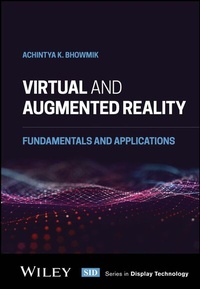
Virtual and Augmented Reality
Beschreibung

A COMPREHENSIVE AND AUTHORITATIVE GUIDE TO THE FOUNDATIONS, TECHNOLOGIES, AND TRANSFORMATIVE APPLICATIONS OF VIRTUAL AND AUGMENTED REALITY.
Virtual and Augmented Reality: Fundamentals and Applications presents an in-depth exploration of the core principles, enabling technologies, and real-world use cases of VR and AR. Designed for use as both a textbook and a professional reference, it offers a rigorous and structured foundation for students, researchers, engineers, and industry practitioners alike.
Grounded in neuroscience and computational perception, the text takes readers from first principles to advanced topics in immersive system architecture and experience design. It emphasizes human-centered systems and multisensory engagement, covering vision, hearing, balance, touch, and smell, along with natural interaction modalities such as gesture, voice, gaze, facial expressions, and direct brain interfaces.
Key features include:
- Foundations of human sensory perception and their technological counterparts in immersive systems
- Advances in 3D graphics, high-fidelity display technologies, spatial audio, computer vision, and motion tracking
- Multimodal interaction and semantic understanding powered by artificial intelligence
- System design and usability considerations for end-to-end VR and AR platforms
- Case studies spanning entertainment, healthcare, education, workforce training, virtual tourism, e-commerce, and more
Authored by a leading innovator in immersive technologies, this book is ideal for advanced instruction and serves as an essential reference for those shaping the future of virtual and augmented reality.
Weitere Details
Weitere Ausgaben
Andere Ausgaben
Person
ACHINTYA K. BHOWMIK, PHD, is Chief Technology Officer at Starkey, a global leader in hearing technology and sensory augmentation, and an Adjunct Professor at Stanford University, where he teaches human-computer interaction and intelligent systems. Previously, he led pioneering work in 3D sensing and perceptual computing at Intel. Dr. Bhowmik is a Fellow of the IEEE, SID, AAIA, and AIIA, and his innovations have been recognized with numerous honors, including TIME's Best Inventions and the Red Dot Design Award. He has authored over 200 publications and multiple books on immersive and interactive technologies.
Inhalt
Series Editor's Foreword xxiii
About the Author xxv
Preface xxvii
Acknowledgments xxix
Section 1 Overview and Evolution 1
1 Overview of Virtual and Augmented Reality: Toward Immersive and Interactive Experiences 3
1.1 Introduction 3
1.2 Key Concepts in Immersive Technologies 4
1.3 Multisensory Immersion and Interaction 7
1.4 Goals of the Book 9
1.5 Overview of the Structure and Content 10
1.6 Conclusion 12
2 The Evolution of Virtual and Augmented Reality: Accomplishments and Challenges 17
2.1 Introduction 17
2.2 Virtual and Augmented Reality in Science Fiction 18
2.3 The Early Concepts Through to the 1950s and 1960s 22
2.4 The 1980s and 1990s: Commercial Exploration 27
2.5 The 2000s: Expansion into New Fields 31
2.6 The 2010s: Technological Innovations and Mainstream Adoption 33
2.7 The 2020s: Integration, Convergence, and Pushing the Frontiers 40
2.8 Challenges and Limitations 45
2.9 Summary 49
Section 2 Sensory-Perceptual Immersion 57
3 Visual Immersion: Foundations of Human Vision 59
3.1 Introduction 59
3.2 Anatomy of the Human Eye 60
3.3 Visual Information Processing in the Brain 64
3.4 Field of View (FOV) for Human Vision 66
3.5 Perception of Depth and Space 67
3.6 Motion Perception 72
3.7 Color Vision 73
3.8 Brightness and Contrast Perception 74
3.9 Summary 76
4 Visual Immersion: Displays and Optics 79
4.1 Introduction 79
4.2 Display System Configurations 80
4.3 Key Attributes of Displays for VR and AR 84
4.4 Display Technologies 89
4.5 Optics for VR and AR Systems 102
4.6 Advanced Topics and Future Trends 107
4.7 Summary 112
5 Visual Immersion: Creating Virtual Worlds with 3D Graphics 119
5.1 Introduction 119
5.2 Fundamentals of Graphics in VR and AR 121
5.3 Rendering Pipeline 124
5.4 Animation and Motion 140
5.5 Advanced 3D Graphics Techniques 142
5.6 Computational Hardware and Software Tools 147
5.7 Future Trends and Innovations 153
5.8 Summary 154
6 Visual Immersion: Understanding and Augmenting the World with Computer Vision 161
6.1 Introduction 161
6.2 Fundamentals of Computer Vision 162
6.3 3D Reconstruction 181
6.4 Augmenting the Reality: Overlaying Virtual on Real 182
6.5 Summary 189
7 Auditory Immersion: Spatial Sound and 3D Audio 195
7.1 Introduction 195
7.2 Basic Principles of Sound Waves 196
7.3 Fundamentals of Human Auditory Perception 198
7.4 Sound Technologies in Virtual and Augmented Reality 210
7.5 Summary 223
8 Vestibular Immersion: Motion Sensing and Stimulation 231
8.1 Introduction 231
8.2 The Human Vestibular System 233
8.3 Creating Vestibular Immersion 236
8.4 Motion Tracking Techniques 237
8.5 Technologies for Vestibular Stimulation 253
8.6 Summary 262
9 Somatosensory Immersion: Touch and Haptic Feedback 273
9.1 Introduction 273
9.2 Physiology of Somatosensory Perception 275
9.3 Haptic Feedback for Immersive Systems 279
9.4 Designing Haptic Feedback Systems 292
9.5 Applications of Haptic Feedback Technologies 295
9.6 Summary 297
10 Olfactory Immersion: Smell Simulation 303
10.1 Introduction 303
10.2 Basics of Olfactory Perception 304
10.3 Enhancing Virtual Experiences with Olfactory Feedback 308
10.4 User Experience Considerations 311
10.5 Future Directions and Innovations 316
10.6 Summary 319
11 Multisensory Integration: Creating Unified Immersive Experiences 325
11.1 Introduction 325
11.2 Foundations of Multisensory Integration 326
11.3 Challenges in Multisensory Integration 332
11.4 Synchronization Across Modalities 334
11.5 Applications of Multisensory Integration 338
11.6 Summary 341
Section 3 Human Inputs and Interactions 349
12 Hand Gesture Recognition: Intuitive Interfaces 351
12.1 Introduction 351
12.2 Physiology of the Human Hand and Gesture Categories 352
12.3 Fundamentals of Hand Gesture Tracking 355
12.4 Gesture Tracking System Architectures 357
12.5 Key Components of Gesture Tracking Systems 360
12.6 Gesture Recognition Algorithms 364
12.7 Applications of Hand Gesture Tracking 371
12.8 Challenges and Limitations 374
12.9 Future Trends and Research Directions 375
12.10 Summary 376
13 Eye-Gaze Tracking: Enabling Adaptive Interactions 385
13.1 Introduction 385
13.2 Physiology of Eye Movement 386
13.3 Types of Eye-Gaze Tracking Systems 390
13.4 Technologies and Methods 391
13.5 Calibration and Accuracy 396
13.6 Integration with VR and AR Systems 399
13.7 Applications of Eye-Gaze Tracking in VR and AR 403
13.8 Challenges and Limitations 405
13.9 Future Trends and Research Directions 406
13.10 Summary 407
14 Speech Recognition: Voice as a Natural Input Modality 415
14.1 Introduction 415
14.2 Fundamentals of Voice Recognition 416
14.3 Types of Voice Recognition Systems 420
14.4 Technologies and Methods 421
14.5 Integration with VR and AR Systems 437
14.6 Applications of Speech Recognition in VR and AR 438
14.7 Challenges and Limitations 440
14.8 Future Directions 442
14.9 Summary 443
15 Facial Expression Recognition: Avatars and Emotional Presence 451
15.1 Introduction 451
15.2 Physiology of the Human Facial Expression 452
15.3 Technologies for Facial Expression Tracking 454
15.4 Real-Time Expression Rendering in Avatars 460
15.5 Personalization and User Representation 464
15.6 Impact on Immersion and Presence 466
15.7 Challenges and Limitations 467
15.8 Summary 469
16 Brain-Computer Interfaces: Direct Neural Interactions 477
16.1 Introduction 477
16.2 BCI Principles and Systems 478
16.3 Hardware Components 484
16.4 Software Components 487
16.5 BCI Applications 491
16.6 Challenges and Limitations 494
16.7 Future Trends and Research Directions 495
16.8 Summary 496
17 Multimodal Interactions: Bridging Inputs for Holistic Experiences 503
17.1 Introduction 503
17.2 The Case for Multimodal Interactions 504
17.3 Principles of Multimodal System Design 506
17.4 Combining Interaction Modalities 508
17.5 Key Technologies for Multimodal Systems 511
17.6 Applications of Multimodal Interactions 512
17.7 Challenges in Multimodal Integration 514
17.8 Future Directions 516
17.9 Summary 517
Section 4 Systems and Applications 525
18 System Architectures and Designs: Integration Challenges 527
18.1 Introduction 527
18.2 Integration Challenges and Usability Considerations 528
18.3 Designing for Scalability and Collaboration 538
18.4 Case Studies in System Integration 539
18.5 Summary 542
19 Applications of Virtual and Augmented Reality: Innovating Across Industries 549
19.1 Introduction 549
19.2 Healthcare and Medicine 550
19.3 Education and Training 553
19.4 Enterprise and Industrial Applications 555
19.5 Entertainment and Media 559
19.6 Retail and E-Commerce 562
19.7 Military and Defense 565
19.8 Arts, Culture, and Tourism 568
19.9 Summary 572
Section 5 Reflections and Outlook 587
20 Accessibility and Inclusivity: Designing Safe and Equitable Systems 589
20.1 Introduction 589
20.2 Principles of Accessible and Inclusive Design 590
20.3 Accessibility Features in Virtual and Augmented Reality Systems 592
20.4 Inclusivity in Multicultural and Global Contexts 600
20.5 Ethical Considerations and User Safety 602
20.6 Summary 606
21 The Simulation Hypothesis: Are We Already Living in a Virtual World? 615
21.1 Introduction 615
21.2 Origins and Theoretical Foundations 616
21.3 Technological Feasibility 617
21.4 Supports and Counterarguments 618
21.5 Societal Implications 620
21.6 Cultural and Psychological Impact 621
21.7 Future Directions and Research 622
21.8 Summary 622
22 Toward the Future: Emerging Directions in Virtual and Augmented Reality 627
22.1 Introduction 627
22.2 Technology Trends Shaping the Future 628
22.3 Expanding Applications 629
22.4 Human-Centric Designs 631
22.5 Challenges and Research Opportunities 632
22.6 The Broader Societal and Cultural Impact 634
22.7 A Vision for the Future 635
22.8 Summary 636
Index 639
1
Overview of Virtual and Augmented Reality: Toward Immersive and Interactive Experiences
1.1 Introduction
Welcome to a journey into the future of human-computer interactions, where the boundaries between reality and imagination blur, and our sensory perceptions are enhanced and augmented. In this first chapter of the book, we will present an overview of the key concepts in virtual reality (VR) and augmented reality (AR) technologies that promise to revolutionize the way we experience and interact with multimedia information and the world around us. As we explore the landscapes these technologies create, we will discover how VR and AR extend our digital capabilities and craft new dimensions of immersive sensory-perceptual experiences. We will explore how these technologies can redefine our relationship with both the digital and physical worlds, offering unprecedented opportunities for innovation and creativity.
The evolution of VR and AR has been marked by significant advancements in transduction, computation, and communication technologies, which have collectively propelled these immersive and interactive experiences from conceptual ideas to practical applications. From gaming and entertainment to education, healthcare, and industry, the applications are vast and varied, promising to enhance every aspect of our lives. This chapter will provide an introduction to these transformative technologies, laying the groundwork for a deeper understanding of their principles, potential, and impact.
As we embark on this exploration, we will examine the technical foundations of virtual and augmented reality and consider the implications these technologies hold for the future. By understanding the mechanisms behind sensory-perceptual immersion, we can appreciate how these technologies can create more engaging and realistic experiences, as well as the significant challenges associated with this endeavor.
We start by reviewing the key concepts and terminologies that are widely used in the field of immersive technologies. Then, we discuss the goals of the book and present an overview of the structure and content flow that will follow.
1.2 Key Concepts in Immersive Technologies
The landscape of immersive technologies has expanded rapidly over the past few decades, driven by advancements in computing, graphics, displays, audio, sensors, and haptics technologies. These innovations have given rise to a range of new tools and platforms that transform how we interact with digital content and the physical world. Central to this transformation are the concepts of VR, AR, merged or mixed reality (MR), extended reality (XR), the metaverse, and spatial computing. Each of these concepts represents unique capabilities and experiences, but they also share common goals: enhancing user immersion, interactivity, and engagement.
Virtual Reality refers to technologies that create a fully immersive digital environment, effectively replacing the user's real-world surroundings with a computer-generated simulation (Burdea & Coiffet, 2003; Sherman & Craig, 2018; Greengard, 2019; LaValle, 2023). This is typically achieved through the use of head-mounted displays (HMDs), which present the user with a stereoscopic view and spatial sound of the virtual world, along with motion tracking systems that capture and interpret the user's movements and map them into the virtual environment. Additional sensory input devices, such as gloves, controllers, and even haptic suits, can enhance the interactivity and realism of the experience. The primary goal of VR is to create a convincing sense of presence, making users feel as though they are truly inside the simulated environment. VR is widely used in various fields, including gaming, where it offers immersive gameplay experiences; simulations for training and education, providing safe and controlled environments for practicing skills; virtual tourism, allowing users to explore distant or inaccessible locations; therapy and rehabilitation, offering controlled environments for therapeutic interventions; social interaction platforms, enabling virtual meetups and collaborative activities; and numerous other immersive applications.
Augmented Reality overlays digital information onto the real-world environment, enhancing and augmenting the user's perception of reality without replacing it (Craig, 2013; Schmalstieg & Hollerer, 2016; Chen et al., 2019). AR devices, which can include smartphones, tablets, smart glasses, and head-up displays (HUDs), project digital elements such as images, videos, sounds, or data onto the user's view of the real world. Unlike VR, which immerses the user in a completely virtual environment, AR integrates digital content with the physical world, providing contextual information and interactive elements that users can see and interact with. AR enhances real-world experiences by adding layers of information that can be accessed in real time. For example, AR can be used in navigation to overlay directions onto the real-world streets, in retail to allow virtual try-ons of clothing or accessories, in education to bring learning materials to life with interactive content, in industrial applications to provide maintenance and repair guidance, and in entertainment through AR games which overlay digital creatures onto real-world environments. AR's ability to blend digital and physical worlds opens up numerous possibilities for enhancing how we interact with our surroundings.
Mixed Reality, a subset of Extended Reality and sometimes referred to as Merged Reality, blends physical and digital worlds, allowing real and virtual elements to coexist and interact seamlessly in real time (Milgram & Kishino, 1994; Wang & Schnabel, 2008; Ohta & Tamura, 2014). MR encompasses both AR and VR, providing a spectrum where digital and real-world objects can interact dynamically. Unlike traditional AR, which can be limited to overlaying digital content onto the real world, MR integrates and anchors digital objects to the physical environment, allowing for more natural and intuitive interactions. MR devices incorporate advanced hardware which can understand and respond to the physical environment through a combination of cameras, sensors, and advanced computing power. This technology enables users to manipulate and interact with both real and virtual elements in a cohesive experience, creating a more immersive and interactive environment. MR is utilized in various fields such as collaborative design, where multiple users can interact with virtual prototypes in a shared physical space; remote assistance, where experts can provide guidance overlaid onto the physical objects being worked on; interactive storytelling, where narratives can unfold around the user; education, providing interactive and engaging learning experiences; and complex data visualization, where abstract data can be visualized in a spatial context.
The Metaverse is the concept of an expansive shared simulated space created by the convergence of physically persistent virtual reality and virtually augmented physical reality (Jaynes et al., 2003; Hazan, 2010; Ball, 2022; Park & Kim, 2022). It represents an interconnected network of immersive digital environments where users can interact, socialize, create, and transact using avatars or digital representations of themselves. The metaverse is envisioned as a successor to the current internet, with an emphasis on shared, persistent, and immersive experiences. Unlike traditional online experiences, which are often isolated and platform-specific, the metaverse aims to be an interconnected and persistent virtual space where activities and interactions continue regardless of individual user presence. Users can move seamlessly between various virtual worlds and environments, each with its own unique characteristics and purposes. The metaverse has the potential to impact numerous aspects of life, including social interactions, where virtual meetups and events can take place; gaming, providing vast and immersive virtual worlds; virtual economies, where users can trade digital goods and services; remote work, offering virtual office spaces and collaboration tools; education, providing immersive learning environments; and entertainment, with virtual concerts, movies, and interactive experiences. Early examples of metaverse concepts include platforms like Second Life, Decentraland, and Meta's Horizon Worlds, which offer glimpses into the potential of these interconnected virtual spaces.
Spatial Computing refers to technologies that enable computers to understand and interact with the physical world in three dimensions, integrating digital information with the user's environment in a way that feels natural and intuitive (Zambonelli & Mamei, 2005; Shekhar & Vold, 2020; Hackl & Cronin, 2024; Xu et al., 2024). It encompasses a range of technologies, including AR, VR, MR, and other sensor-driven environments that recognize the spatial relationship between objects and the environment. Spatial computing allows for more intuitive and natural user interactions with digital content by understanding and responding to the physical context of the user. Devices equipped with spatial computing capabilities can map and understand the physical environment, recognizing objects, surfaces, and spatial relationships. This spatial awareness enables dynamic...
