

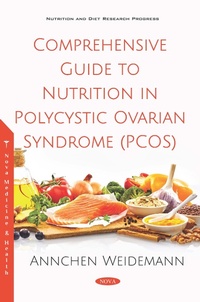
Comprehensive Guide to Nutrition in Polycystic Ovarian Syndrome (PCOS)
Erschienen am 27. Juni 2019
190 Seiten
978-1-5361-5656-0 (ISBN)
Beschreibung

Polycystic ovarian syndrome (PCOS) is the single largest cause of infertility in women of childbearing age, with the incidence having risen from around 15 % to 21 % within 6 - 8 years. Not only has the incidence risen in this population, but in adolescents, PCOS is being diagnosed earlier and more frequently, than ever before. There is no written "diet" or single food that cures PCOS, but factors from Westernized eating such as trans fats, advanced glycation end-products and fructose overload, are factors which affect both the development of PCOS and the resistance to drug-related treatment of it. For the woman with PCOS, whether trying to fall pregnant of manage symptoms, it is of cardinal importance to understand that a "diet mentality"' is inappropriate, since the entire lifestyle should be changed to favour the menstrual cycle and the production of its hormones for at least 3three months prior to expecting normal ovulation. The awakening and development of the primordial follicle destined to become the ovulatory one, 85 days prior to ovulation, points to the compulsory consistency of improved eating habits and lifestyle. Almost every single food/meal/drink/snack has an influence on your ovulatory capacity. It is imperative that the PCOS woman seeking help for either symptomatic relief or fertility, understands the relationship of the hormonal chaos of PCOS to the hormonal chaos of a poor diet. The standard dietary composition, of 20 % protein, 50 % carbohydrate and 30 % fat, was used to treat PCOS since the beginning of research, after the discovery of PCOS as Stein-Leventhal syndrome in 1935. Weight loss was known to be the most important factor in treating PCOS, but no progress was made, and the drop-out rate of diets given to these women was extremely high. For some reason, women with PCOS could not adhere to a formal diet, and battled weight loss, although small studies could not confirm this. The answer to this probably lies in the disturbance of their hunger and satiety cascade, regulated by insulin. New drugs have seen the light and were tested on females with PCOS with mediocre results, showing that something else but the PCOS was at play. This book is dedicated to show the power and strength of poor dietary habits (and visa versa) on drug treatment of PCOS, and the lack of need for it when dietary habits and lifestyles are improved. In PCOS, drugs could probably never win over a poor eating lifestyle, which is a point often missed by fertility specialists eager to help with a quick -fix, rather than a longer process that can be maintained over the long-term. The mere fact that in women undergoing IVF treatment, end-stage-glycation products were found in their oocytes, tells a story of the horrendous effect of poor dietary habits on fertility. Both the keto-genic diet and intermittent fasting (done under professional dietetic supervision), either apart or together, have provided a means for quicker and safer weight loss, especially if time is of the essence in older couples.
Weitere Details
Weitere Ausgaben
Andere Ausgaben
Annchen Weidemann
Comprehensive Guide to Nutrition in Polycystic Ovarian Syndrome (PCOS)
Buch
06/2019
Nova Science Publishers Inc
126,20 €
Versand in 15-20 Tagen
Inhalt
- Intro
- Contents
- List of Tables
- List of Figures
- Preface
- Acknowledgments
- List of Acronyms and Abbreviations
- Part I: The Science behind the Disorder of Polycystic Ovary Syndrome (PCOS)
- Chapter 1
- About Polycystic Ovarian Syndrome
- 1.1. History of Polycystic Ovarian Syndrome
- 1.2. The Female Reproductive System
- 1.2.1. An Introduction to Follicles
- 1.2.2. The First Eighty-Five (85) Days of Follicle Development
- 1.2.3. The Normal Development of Ovarian Follicles during the Menstrual Cycle
- 1.3. Stages of Follicle Development
- 1.3.1. The Hormonal Cascade in Follicle Development
- 1.3.2. Importance of Theca and Granulosa Cells
- 1.4. The Impact of PCOS on the Menstrual Cycle
- 1.5. Clinical Presentation of PCOS
- 1.5.1. Measurable, Clinical Symptoms
- 1.5.2. Subjective, Self-Reported Symptoms
- 1.5.3. Depression, Anxiety, Quality of Life, and Disordered Eating
- 1.6. Definition and Diagnosis of PCOS
- 1.6.1. NIH 1990 Criteria
- 1.6.2. Rotterdam 2003 Criteria
- 1.6.3. AE-PCOS Criteria of 2006 & 2009
- 1.6.4. NIH 2012 Criteria
- 1.7. Prevalence and Health Risks of PCOS
- Chapter 2
- Factors in the Pathophysiology of PCOS
- 2.1. Overview
- 2.2. The Effect of Insulin on PCOS
- 2.3. Effect of Insulin on the HPO-Axis
- 2.4. Insulin Resistance, PCOS and the Metabolic Syndrome
- 2.5. Insulin Resistance, Hyperandrogenism and PCOS
- 2.6. Obesity and Fat Distribution
- 2.7. Abdominal Fat-Cell Dysfunction and PCOS
- 2.7.1. Leptin
- 2.7.2. Adiponectin
- 2.8. Nutrition-Related Factors Relevant to Ovarian Dysfunction
- 2.8.1. Nutrient Excess
- 2.8.1.1. Adipose Tissue
- 2.8.1.2. Reproduction
- 2.8.1.3. Liver
- 2.8.1.4. Pancreas
- 2.8.2. Nutrition-Induced Inflammation
- 2.8.3. Advanced Glycation End-Products (AGEs)
- 2.8.4. Trans Fats
- 2.8.5. Fructose: The Effect of Excessive Fructose Consumption on the Development of Insulin Resistance and Metabolic Syndrome
- 2.8.5.1. Differences in Metabolic Pathways of Glucose and Fructose
- 2.8.5.2. Fructose Contents of Different Sources
- 2.8.6. Fructose: A Highly-Lipogenic Nutrient
- 2.9. The Role of Anti-Müllerian Hormone
- 2.10. Genetic and Androgen Exposure Factors and PCOS
- 2.11. Environmental Factors and PCOS
- 2.11.1. Smoking
- 2.11.2. Drugs, Caffeine and Alcohol
- 2.11.3. Physical Activity
- 2.11.4. Environmental Pollutants
- 2.11.4.1. Organic Solvents
- 2.11.4.2. Aromatic Amines
- 2.11.4.3. Heavy Metals
- 2.11.5. Shift Work
- 2.12. The Role of Appetite Regulation in PCOS
- 2.12.1. Cholecystokinin
- 2.12.2. Ghrelin
- 2.12.3. Leptin
- Chapter 3
- Brief Overview of Drugs and Surgery Used for Treatment in PCOS
- 3.1. Menstrual Irregularities and the Use of Oral Contraceptive Pills
- 3.2. Fertility
- 3.2.1. Anti-Estrogens
- 3.2.2. Insulin Sensitizers
- 3.2.3. Ovarian Drilling
- 3.2.4. Gonadotropins
- 3.2.5. Assisted Reproductive Technology
- 3.2.6. Bariatric Surgery
- Chapter 4
- Alternative and Complementary Treatments for Use in PCOS
- 4.1. Myo-Inositol and D-Chiro-Inositol
- 4.2. Berberine
- 4.3. N-Acetyl Cysteine
- 4.4. Resveratrol
- 4.5. Folic Acid
- 4.5.1. Overview of Folate and Folic Acid
- 4.5.2. Dietary Need for Folic Acid
- 4.5.3. Recommendations
- 4.6. Vitamin D
- 4.7. Adiponectin
- 4.8. Fatty Acids
- 4.8.1. Overview of Fatty Acids
- 4.8.2. Supplementation of Fatty Acids
- Chapter 5
- PCOS in Adolescence
- 5.1. Overview
- 5.2. Investigations and Diagnosis of PCOS in Adolescence
- 5.2.1. Androgen Excess
- 5.2.2. Irregular Menses
- 5.2.3. Ovarian Polycystic Morphology
- 5.3. Obesity, Insulin Resistance and Metabolic Risk
- 5.4. Treatment of PCOS in Adolescence
- Part II: Nutritional Considerations and Treatment Strategies for the Woman with PCOS
- Chapter 6
- The Optimal Diet for PCOS
- 6.1. A Historical Overview
- 6.2. The Nurses' Health Study
- 6.2.1. Nurses' Health Study: Original Cohort
- 6.2.2. Why Nurses?
- 6.2.3. Establishing the Cohort
- 6.3. Dropout
- 6.4. Dietary Entities of Concern to PCOS Nutrition
- 6.4.1. Trans Fat
- 6.4.2. Glycemic Index and Glycemic Load
- 6.4.3. Protein
- 6.4.3.1. Iron in Protein-Rich Foods
- 6.4.3.2. Bioavailability of Non-Heme Sources of Iron
- 6.4.3.3. Benefits of Higher Protein
- 6.4.4. Fructose Excess and AGEs
- 6.4.5. Dairy Products
- 6.4.5.1. Hormones in Milk
- 6.4.5.2. Other Additions to Milk
- 6.4.5.3. Recommendations
- 6.4.6. Gluten
- 6.4.7. Food Cravings
- 6.4.8. Meal Frequency and Snacking
- Chapter 7
- New Dietary Strategies for Treatment in PCOS
- 7.1. Introduction
- 7.2. What Do We Know for Sure?
- 7.3. The Ketogenic and Low Carbohydrate Diet
- 7.4. Intermittent Fasting
- 7.4.1. Methods of Intermittent Fasting as a Lifestyle
- 7.4.2. Combining Ketogenesis with Intermittent Fasting
- 7.5. Overcoming the "Diet" Mentality
- 7.6. A Final Word
- References
- Author's Contact Information
- Index
- Blank Page
