

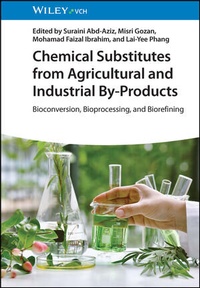
Chemical Substitutes from Agricultural and Industrial By-Products
Bioconversion, Bioprocessing, and Biorefining
1. Auflage
Erschienen am 13. September 2023
XV, 416 Seiten
978-3-527-84112-7 (ISBN)
Beschreibung

Covers the individual aspect in bioconversion, bioprocessing and downstream process of chemical substitutes produced from agricultural and industrial by-products.
Weitere Details
Weitere Ausgaben
Andere Ausgaben
Suraini Abd-Aziz | Misri Gozan | Mohamad Faizal Ibrahim
Chemical Substitutes from Agricultural and Industrial By-Products
Bioconversion, Bioprocessing, and Biorefining
Buch
10/2023
1. Auflage
Wiley-VCH
149,00 €
Versand in 5-7 Tagen
Personen
Suraini Abd-Aziz is Professor at the Department of Bioprocess Technology, Faculty of Biotechnology and Biomolecular Sciences, Universiti Putra Malaysia, Serdang, Selangor, Malaysia. She is currently the AFOB Vice President of Malaysia region, President of AFOB Malaysia Chapter, and AFOB Co-Chair of Bioenergy and Biorefinery Division. She graduated with a B.Sc. (Honours) Clinical Biochemistry from Universiti Kebangsaan Malaysia (the National University of Malaysia) in 1992, M.Sc. (Biochemical Engineering) from the University of Wales Swansea, United Kingdom, in 1994, and PhD (Biochemical Engineering) from the University of Wales Swansea, United Kingdom, in 1997. In research, she had developed her research interest in the field of Industrial Biotechnology specialized in bioenergy and biobased chemical, which focused on the utilization of agro wastes for bioenergy and value-added products toward zero waste emission. She is one of the Malaysia Top Research Scientists (TRSM 2018). Apart from being the project leader of her own research grants, she also actively contributed to other projects in her capacity as an expert in enzyme technology, fermentation technology, bioprocess engineering, and environmental biotechnology.
Misri Gozan is Professor of Bioprocess Engineering, Universitas Indonesia, Indonesia. He was the former of the Asian Federation of Biotechnology AFOB Vice President of the Indonesia region. He completed his Bachelor of Engineering Education in the Department of Gas and Petrochemical Engineering Universitas Indonesia in 1993. He earned a Master in Technology in the field of Process and Environmental Engineering from Massey University, Palmerston North, New Zealand, in 1998. In 2004, he finished his Doctor of Ingineuer at the Faculty of Geology, Forestry and Hydrology, TU Dresden, Germany. His research works were published in international articles related to bioprocess engineering, especially in the efficacy of biochemicals extracted from Nicotiana tabacum, biochemical synthesis from agricultural solid waste, and oil extraction of indigenous plants.
Mohamad Faizal Ibrahim is Associate Professor at the Department of Bioprocess Technology, Faculty of Biotechnology and Biomolecular Sciences, Universiti Putra Malaysia. He obtained his Bachelor of Science (Biotechnology) in 2009 and PhD (Environmental Biotechnology) in 2013, both from UPM before being appointed as a senior lecturer at UPM in 2013. His works mostly on the utilization of biomass into value-added products such as enzymes, biofuels, biosugars, animal feed, activated carbon, essential oils, and other biobased chemicals, which cover various bioprocessing approaches such as fermentation, extraction, pretreatment, carbonization, and activation. He is a member of the AFOB and currently the Secretary of the AFOB Malaysia Chapter.
Lai-Yee Phang is Associate Professor at the Department of Bioprocess Technology, Universiti Putra Malaysia, Serdang Malaysia. She graduated with a Bachelor of Science (Biotechnology) in 1998 from the Department of Biotechnology, Faculty of Food Science and Biotechnology, UPM, and obtained a Master degree in Science in the field of Environmental Biotechnology at the same department in 2001. She pursued her PhD study at Kyushu Institute of Technology, Japan. Her research interest is in Environmental Biotechnology, focusing on the conversion of waste materials into valuable products such as fine chemicals and biofuels, which includes screening of microorganisms, fermentation, optimization, and pretreatment. She is also working on the phytoremediation of contaminated soil. She is a member of the AFOB and currently the Treasurer of the AFOB Malaysia Chapter.
Misri Gozan is Professor of Bioprocess Engineering, Universitas Indonesia, Indonesia. He was the former of the Asian Federation of Biotechnology AFOB Vice President of the Indonesia region. He completed his Bachelor of Engineering Education in the Department of Gas and Petrochemical Engineering Universitas Indonesia in 1993. He earned a Master in Technology in the field of Process and Environmental Engineering from Massey University, Palmerston North, New Zealand, in 1998. In 2004, he finished his Doctor of Ingineuer at the Faculty of Geology, Forestry and Hydrology, TU Dresden, Germany. His research works were published in international articles related to bioprocess engineering, especially in the efficacy of biochemicals extracted from Nicotiana tabacum, biochemical synthesis from agricultural solid waste, and oil extraction of indigenous plants.
Mohamad Faizal Ibrahim is Associate Professor at the Department of Bioprocess Technology, Faculty of Biotechnology and Biomolecular Sciences, Universiti Putra Malaysia. He obtained his Bachelor of Science (Biotechnology) in 2009 and PhD (Environmental Biotechnology) in 2013, both from UPM before being appointed as a senior lecturer at UPM in 2013. His works mostly on the utilization of biomass into value-added products such as enzymes, biofuels, biosugars, animal feed, activated carbon, essential oils, and other biobased chemicals, which cover various bioprocessing approaches such as fermentation, extraction, pretreatment, carbonization, and activation. He is a member of the AFOB and currently the Secretary of the AFOB Malaysia Chapter.
Lai-Yee Phang is Associate Professor at the Department of Bioprocess Technology, Universiti Putra Malaysia, Serdang Malaysia. She graduated with a Bachelor of Science (Biotechnology) in 1998 from the Department of Biotechnology, Faculty of Food Science and Biotechnology, UPM, and obtained a Master degree in Science in the field of Environmental Biotechnology at the same department in 2001. She pursued her PhD study at Kyushu Institute of Technology, Japan. Her research interest is in Environmental Biotechnology, focusing on the conversion of waste materials into valuable products such as fine chemicals and biofuels, which includes screening of microorganisms, fermentation, optimization, and pretreatment. She is also working on the phytoremediation of contaminated soil. She is a member of the AFOB and currently the Treasurer of the AFOB Malaysia Chapter.
Inhalt
A Glance on Biorefinery of Chemical Substitutes from Agriculture and Industrial By-Products
Anti-Oxidant from Agricultural Wastes and their Potential Applications
Lemongrass Oleoresin for Food Flavouring
Nanocarbon Material and Chemicals from Seaweed for Energy Storage Components
Spent Mushroom Substrate as Alternative Source for the Production of Chemical Substitutes
Essential Oil from Pineapple Wastes
Chicken Feather as a Bioresource to Produce Value-Added Bioproducts
Biobleaching Agents Used for Paper and Pulp Produced from the Valorization of Corn Cob, Wheat Straw, and Baggase
Recovery of Industrially Useful Enzymes from Rubber Latex Processing By-Products
Sago Wastes as a Feedstock for Biosugar, Precursor for Chemical Substitutes
Biofertiliser and Other Chemical Substitutes from Sugarcane By-Products
Cocoa Butter Substitute from Tengkawang (Shorea Stenoptera)
Bio-Succinic Acids Production from Biomass and Their Applications
Furfural and Derivatives from Baggase and Corn Cob
Levulinic Acids and Formic Acid from Rice Straw and Sugarcane Baggase
Cellulase as Biocatalyst Produce from Agricultural Wastes
Conversion of Glycerol Derived from Biodiesel Production into Butanol and 1,3 Propanediol
Sustainability of Chemical Substitutes from Agriculturral and Industrial By-Products
Anti-Oxidant from Agricultural Wastes and their Potential Applications
Lemongrass Oleoresin for Food Flavouring
Nanocarbon Material and Chemicals from Seaweed for Energy Storage Components
Spent Mushroom Substrate as Alternative Source for the Production of Chemical Substitutes
Essential Oil from Pineapple Wastes
Chicken Feather as a Bioresource to Produce Value-Added Bioproducts
Biobleaching Agents Used for Paper and Pulp Produced from the Valorization of Corn Cob, Wheat Straw, and Baggase
Recovery of Industrially Useful Enzymes from Rubber Latex Processing By-Products
Sago Wastes as a Feedstock for Biosugar, Precursor for Chemical Substitutes
Biofertiliser and Other Chemical Substitutes from Sugarcane By-Products
Cocoa Butter Substitute from Tengkawang (Shorea Stenoptera)
Bio-Succinic Acids Production from Biomass and Their Applications
Furfural and Derivatives from Baggase and Corn Cob
Levulinic Acids and Formic Acid from Rice Straw and Sugarcane Baggase
Cellulase as Biocatalyst Produce from Agricultural Wastes
Conversion of Glycerol Derived from Biodiesel Production into Butanol and 1,3 Propanediol
Sustainability of Chemical Substitutes from Agriculturral and Industrial By-Products
