

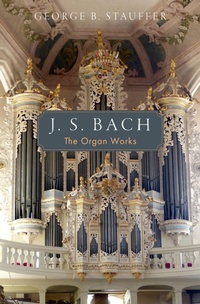
J. S. Bach
The Organ Works
Erschienen am 29. August 2024
Buch
Hardcover
648 Seiten
978-0-19-510802-6 (ISBN)
Beschreibung
In the obituary that appeared soon after his death, Johann Sebastian Bach was described as "the world-famous organist" and "the greatest organist...we have ever had." In Hamburg, Dresden, and other big cities, Bach dazzled audiences with his organ playing, performing passages with his feet that many thought impossible for the hands. One eyewitness declared that he had never seen anything like it. His extant organ works--more than 250 chorale settings and free pieces--are filled with bold, dramatic passages and fully independent pedal parts. They represent the most important body of music in the organ repertoire and the only genre that Bach turned to continuously throughout his life, from his earliest efforts as a teenager in Ohrdruf to his final deathbed revisions as a cantor in Leipzig.
In this new survey, leading musicologist George B. Stauffer traces the evolution of Bach's organ works within the broad spectrum of his development as a composer. With detailed discussions of the individual pieces, the book shows how Bach initially drew on contemporary models from Germany and France before evolving a personal idiom based on the concertos of Antonio Vivaldi. In Leipzig, he went still further, synthesizing national and historical styles to produce cosmopolitan masterpieces that exude sophistication and elegance. Serving as a backdrop to this growth was the emergence of the Central German pre-Romantic organ, which inspired Bach to write pieces with unique chamber-music, choral, and orchestral qualities. Stauffer follows these developments step-by-step, showing how Bach's unending quest for novelty, innovation, and refinement resulted in organ works that continue to reward and awe listeners today.
In this new survey, leading musicologist George B. Stauffer traces the evolution of Bach's organ works within the broad spectrum of his development as a composer. With detailed discussions of the individual pieces, the book shows how Bach initially drew on contemporary models from Germany and France before evolving a personal idiom based on the concertos of Antonio Vivaldi. In Leipzig, he went still further, synthesizing national and historical styles to produce cosmopolitan masterpieces that exude sophistication and elegance. Serving as a backdrop to this growth was the emergence of the Central German pre-Romantic organ, which inspired Bach to write pieces with unique chamber-music, choral, and orchestral qualities. Stauffer follows these developments step-by-step, showing how Bach's unending quest for novelty, innovation, and refinement resulted in organ works that continue to reward and awe listeners today.
Rezensionen / Stimmen
George Stauffer takes us on a compelling journey through Bach's life and the organs he played, providing a rich and fascinating context for his organ music. The author discusses each work, incorporating information from recent discoveries that broaden our understanding of how the iconic compositions were disseminated and performed. Stauffer's study is a must-read for anyone interested in Bach's music for the organ! * Kimberly Marshall, Goldman Endowed Professor of Organ, Arizona State University * Stauffer's fascinating introduction to Bach's Organ Works combines decades of familiarity with Bach's organ music as a practicing organist with the deep erudition of a music historian. The book sheds new light on the musical and social contexts of Bach's organ music and provides a unique perspective of the place of the organ works in Bach's own artistic development. The book will be indispensable for performers, listeners, and music historians." -=-Markus Rathey, Yale University George Stauffer has been at the forefront of researching Bach's organ music for about fifty years. His new book on all the composer's organ works not only provides an up-to-date and useful chronological overview but also many new details and insightful observations. * Christoph Wolff, Adams University Professor Emeritus, Harvard University * The style of writing balances the twin strands of analysis and performance, clearly coming from an author that has been studying and playing the music of Bach for many decades. As I read through the book, I almost felt that Stauffer was standing beside me at the console offering guidance on how best to convey Bach's intentions. The book complements the many books by Williams and Wolff and should be on your physical and/or digital bookcase as soon as possible * Martin White, Manuals and pedals - an organist's odyssey * Bach emerges from Stauffer's study as someone we understand, a musician who traversed professional and personal successes and setbacks to develop a transformative body of work. * Kimberly Marshall, The American Organist * In this monumental study Stauffer (Rutgers Univ.), a renowned organist and expert on Bach's organ music, discusses in detail Bach's vast and lasting contribution to organ literature. Bach was reputed to be the greatest organist in existence during his life. This book is organized in chronological order, covering the five main portions of Bach's life and career from beginnings at Eisenach to the culmination of his career in Leipzig...This book is essential for academic libraries with music research collections and public libraries with significant music collections. * Choice * George Stauffer's book will undoubtedly attract a broad and diverse readership. Scholars will appreciate the robust and up-todate bibliography, with long-standing as well as recent research results woven seamlessly into every chapter. Practicing organists will be fascinated by the wealth of organological information. Enthusiasts and even newcomers to Bach's music and biography will certainly be drawn in by the cogent, engagingly written topical introductions. But above all, Stauffer's greatest contribution is the compelling, panoramic chronological narrative that shapes the entire study. It is indeed a fully integrated "history of Bach's organ music." * James A. Brokaw II, BACH: Journal of the Riemenschneider Bach Institute * George B. Stauffer's newly released J. S. Bach: The Organ Works is a true tour de force. * James A. Brokaw II, BACH: Journal of the Riemenschneider Bach Institute, Puritan Reformed * This is an intelligently conceived and brilliantly executed projectthat fills a tremendous need. It is also remarkably affordable and should have wide appeal to individuals as well as libraries. It will quickly join many of Stauffer's other publications as a standard reference and may well come to be viewed as a landmark work of Bach scholarship. * David Crean, Notes: the Quarterly Journal of the Music Library Association *Weitere Details
Sprache
Englisch
Verlagsort
New York
USA
Zielgruppe
Für Beruf und Forschung
Illustrationen
138 music examples, 31 halftones, 7 line drawings, 10 tables
Maße
Höhe: 242 mm
Breite: 161 mm
Dicke: 48 mm
Gewicht
1078 gr
ISBN-13
978-0-19-510802-6 (9780195108026)
Copyright in bibliographic data and cover images is held by Nielsen Book Services Limited or by the publishers or by their respective licensors: all rights reserved.
Schweitzer Klassifikation
Weitere Ausgaben
Andere Ausgaben
Person
George B. Stauffer is Distinguished Professor of Music History and Dean Emeritus of the Mason Gross School of the Arts, Rutgers University. He is well known for his writings on the music and culture of the Baroque Era and the life and works of Johann Sebastian Bach, in particular. He has written or edited eight books, including Bach: The Mass in B Minor and The World of Baroque Music, and he has contributed numerous articles to American, European, and Asian journals. He has also written pieces for The New York Review of Books, The New York Times, and The Weekly Standard. Stauffer has held Guggenheim, Fulbright, ACLS, IREX, and Bogliasco fellowships, and he is a frequent speaker at Bach festivals, concert halls, and universities in the United States and abroad. A past President of the American Bach Society, Stauffer is General Editor of the Leupold Edition of The Complete Organ Works of Johann Sebastian Bach.
Inhalt
Preface
Abbreviations and Terms
Introduction: The World of Bach's Organ Music
Central German Music Culture ~ Grandest Machine of All ~ Transmission of Bach's Organ Works
Part I - Learning the Craft: Eisenach, Ohrdruf, Lueneburg, and Weimar (1685-1703)
1 - The Young Bach
Eisenach ~ Ohrdruf ~ Lueneburg ~ Weimar
2 - Study and Models
Ohrdruf: Johann Christoph Bach and Thuringian Circles ~ Lueneburg: Georg Boehm and North German Circles
3 - Initial Efforts
Neumeister Chorales ~ Free Works
Part II - The "First Fruits": Arnstadt and Muehlhausen (1703-1708)
4 - Bach in Arnstadt and Muehlhausen
Organist at the New Church ~ Luebeck Pilgrimage ~ Organist at St. Blasius's Church
5 - Chorale-based Works
Chorale Settings ~ Chorale Partitas
6 - Free Works
Multi-sectional Praeludia ~ Prelude-Fugue Pairs ~ Independent Fugues ~ Unica
Part III - "The Golden Years": Weimar (1708-1717)
7 - Bach in Weimar
Organist and Chamber Musician at the Weimar Court ~ Chapel Organ and Other Instruments ~ New Connections, New Influences ~ Eclectic Blends and Hybrid Forms
8 - The Orgel-Buechlein
Compositional History ~ Function in Weimar ~ Musical Style: Melody Chorales, Canonic Chorales, Florid-Melody Chorales, Unique Settings
9 - Concerto Transcriptions
Incomparable Things ~ Challenges of Transcription Process ~ The Music: Vivaldi Transcriptions, Johann Ernst Transcriptions ~ Bach versus Vivaldi
10 - Large Chorale Settings
Fore-Imitation Settings ~ Florid-Melody Settings ~ Chorale Trios ~ Cantus Firmus Settings ~ Eclectic Blends ~ Sei gegruesset, Jesu guetig
11 - Small Chorale Settings
Miscellaneous Manual Works ~ Chorale Fughettas ~ Congregational Accompaniment: Figured-Bass and Interlude Settings
12 - Free Works: Prelude-Fugue Pairs
Prelude and Fugue Ideal ~ Modification of North German and French Idioms ~ Adoption of Italian Concerto Principles
13 - Free Works: Independent Fugues and Singular Pieces
Independent Fugues ~ Experimental Forms ~ The Great Passacaglia
Part IV - The Organist as Capellmeister: Coethen (1717-1723)
14 - Bach in Coethen
Capellmeister at the Coethen Court ~ Repertory ~ New Stylistic Developments ~ Organ Inspections and Performances
15 - Organ Teacher, Consultant, and Recitalist
Didactic Works ~ Organ Pedagogue ~ Organ Examiner and Consultant ~ Organ Recitalist
16 - Bach's Art of Registration
The German Tradition ~ Full Organ ~ All the Remaining Diverse Variations ~ Hymn Accompaniment ~ Particular Stops and Combinations
Part V - The Grand Synthesis: Leipzig (1723-1750)
17 - Bach in Leipzig
St. Thomas Cantor and Director of Music ~ Fusion of Styles ~ New Role of Revision and Recycling ~ Central German Organ
18 - Cantata and Passion Movements with Obbligato Organ and Miscellaneous Trios
Obbligato Organ Repertory ~ Performance Considerations ~ Musical Style ~ Trio Transcriptions and Compositions ~ Function of the Pieces ~ Stylistic Aspects
19 - Six Sonatas
The Genesis of the Collection ~ Pedagogical Use ~ Musical Style ~ Performance Issues ~ Postscript
20 - Free Works: Prelude and Fugues
An Unorthodox Transcription ~ Four Monumental Works
21 - Free Works: Singular Pieces
Singular Pieces ~ Prelude and Fugues: Final Directions
22 - Clavier-UEbung III
The Clavier-UEbung Series ~ Genesis of the Original Print ~ The Music ~ Structure of the Collection ~ Duets ~ Reception of the Music
23 - Canonic Variations on "Vom Himmel hoch, da komm ich her"
The Canonic Variations Project ~ The Music ~ Organizational Schemes
24 - The Schuebler Chorales
The Problematic Original Print ~ Hand-Corrected Copies ~ The Music ~ Structure of the Collection ~ Significance of the Settings
25 - Nineteen Large Chorales of Various Kinds
The Leipzig Chorale Portfolio ~ Why These Settings? ~ The Revisions ~ Unanswered Questions ~ Search for Perfection
Appendix: Three Central German Organs, specifications
Abbreviations and Terms
Introduction: The World of Bach's Organ Music
Central German Music Culture ~ Grandest Machine of All ~ Transmission of Bach's Organ Works
Part I - Learning the Craft: Eisenach, Ohrdruf, Lueneburg, and Weimar (1685-1703)
1 - The Young Bach
Eisenach ~ Ohrdruf ~ Lueneburg ~ Weimar
2 - Study and Models
Ohrdruf: Johann Christoph Bach and Thuringian Circles ~ Lueneburg: Georg Boehm and North German Circles
3 - Initial Efforts
Neumeister Chorales ~ Free Works
Part II - The "First Fruits": Arnstadt and Muehlhausen (1703-1708)
4 - Bach in Arnstadt and Muehlhausen
Organist at the New Church ~ Luebeck Pilgrimage ~ Organist at St. Blasius's Church
5 - Chorale-based Works
Chorale Settings ~ Chorale Partitas
6 - Free Works
Multi-sectional Praeludia ~ Prelude-Fugue Pairs ~ Independent Fugues ~ Unica
Part III - "The Golden Years": Weimar (1708-1717)
7 - Bach in Weimar
Organist and Chamber Musician at the Weimar Court ~ Chapel Organ and Other Instruments ~ New Connections, New Influences ~ Eclectic Blends and Hybrid Forms
8 - The Orgel-Buechlein
Compositional History ~ Function in Weimar ~ Musical Style: Melody Chorales, Canonic Chorales, Florid-Melody Chorales, Unique Settings
9 - Concerto Transcriptions
Incomparable Things ~ Challenges of Transcription Process ~ The Music: Vivaldi Transcriptions, Johann Ernst Transcriptions ~ Bach versus Vivaldi
10 - Large Chorale Settings
Fore-Imitation Settings ~ Florid-Melody Settings ~ Chorale Trios ~ Cantus Firmus Settings ~ Eclectic Blends ~ Sei gegruesset, Jesu guetig
11 - Small Chorale Settings
Miscellaneous Manual Works ~ Chorale Fughettas ~ Congregational Accompaniment: Figured-Bass and Interlude Settings
12 - Free Works: Prelude-Fugue Pairs
Prelude and Fugue Ideal ~ Modification of North German and French Idioms ~ Adoption of Italian Concerto Principles
13 - Free Works: Independent Fugues and Singular Pieces
Independent Fugues ~ Experimental Forms ~ The Great Passacaglia
Part IV - The Organist as Capellmeister: Coethen (1717-1723)
14 - Bach in Coethen
Capellmeister at the Coethen Court ~ Repertory ~ New Stylistic Developments ~ Organ Inspections and Performances
15 - Organ Teacher, Consultant, and Recitalist
Didactic Works ~ Organ Pedagogue ~ Organ Examiner and Consultant ~ Organ Recitalist
16 - Bach's Art of Registration
The German Tradition ~ Full Organ ~ All the Remaining Diverse Variations ~ Hymn Accompaniment ~ Particular Stops and Combinations
Part V - The Grand Synthesis: Leipzig (1723-1750)
17 - Bach in Leipzig
St. Thomas Cantor and Director of Music ~ Fusion of Styles ~ New Role of Revision and Recycling ~ Central German Organ
18 - Cantata and Passion Movements with Obbligato Organ and Miscellaneous Trios
Obbligato Organ Repertory ~ Performance Considerations ~ Musical Style ~ Trio Transcriptions and Compositions ~ Function of the Pieces ~ Stylistic Aspects
19 - Six Sonatas
The Genesis of the Collection ~ Pedagogical Use ~ Musical Style ~ Performance Issues ~ Postscript
20 - Free Works: Prelude and Fugues
An Unorthodox Transcription ~ Four Monumental Works
21 - Free Works: Singular Pieces
Singular Pieces ~ Prelude and Fugues: Final Directions
22 - Clavier-UEbung III
The Clavier-UEbung Series ~ Genesis of the Original Print ~ The Music ~ Structure of the Collection ~ Duets ~ Reception of the Music
23 - Canonic Variations on "Vom Himmel hoch, da komm ich her"
The Canonic Variations Project ~ The Music ~ Organizational Schemes
24 - The Schuebler Chorales
The Problematic Original Print ~ Hand-Corrected Copies ~ The Music ~ Structure of the Collection ~ Significance of the Settings
25 - Nineteen Large Chorales of Various Kinds
The Leipzig Chorale Portfolio ~ Why These Settings? ~ The Revisions ~ Unanswered Questions ~ Search for Perfection
Appendix: Three Central German Organs, specifications