

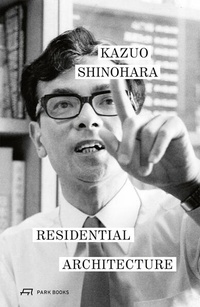
Residential Architecture
Beschreibung
Kazuo Shinohara's (1925-2006) book Residential Architecture is considered one of the most significant pieces of writing on Japanese architecture of the late 20th century. First published in Japan in 1964 as Jutaku kenchiku, the book was mandatory reading for generations of students of architecture in Japan, and has deeply influenced many of the best-known Japanese designers, such as Toyo Ito, Kazuyo Sejima, Ryue Nishizawa, and others.
Shinohara's reflections on housing are now available in English for the first time, translated by architectural historian David B. Stewart (1942-2025) and architects Shin-ichi Okuyama and Kenichi Nakamura. The multifaceted insights into the ideational fundamentals of his outstanding work are thus accessible to a global audience. In the first of three chapters, Shinohara writes about traditional Japanese architecture, thus explaining the foundation of his theory and practice. This is followed by a description of his design method, which he further illustrates in the third part through the examples of his first seven designs for homes.
Weitere Details
Personen
Kazuo Shinohara (1925-2006) is widely revered as one of the most eminent and influential modern Japanese architects. He graduated from Tokyo Institute of Technology in 1953, where he also became a professor in 1970, and established his own Tokyo-based practice in 1954, going on to design more than 30 residential buildings, as well as many key public buildings across Japan.
Christian Dehli and Andrea Grolimund founded their Zurich-based architecture firm Dehli Grolimund in 2019, when they also published their first book, Kazuo Shinohara-3 Houses . In 2022, they oversaw the reconstruction of Kazuo Shinohara's relocated Umbrella House (1961) on the Vitra Campus in Weil am Rhein, Germany.