

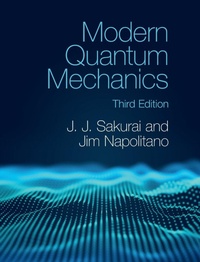
Modern Quantum Mechanics
3. Auflage
Erschienen am 17. September 2020
Buch
Hardcover
566 Seiten
978-1-108-47322-4 (ISBN)
Beschreibung
Modern Quantum Mechanics is a classic graduate level textbook, covering the main concepts from quantum mechanics in a clear, organized and engaging manner. The original author, J. J. Sakurai, was a renowned particle theorist. This third edition, revised by Jim Napolitano, introduces topics that extend its value into the twenty-first century, such as modern mathematical techniques for advanced quantum mechanical calculations, while at the same time retaining fundamental topics such as neutron interferometer experiments, Feynman path integrals, correlation measurements, and Bell's inequalities. A solutions manual is available.
Rezensionen / Stimmen
'A truly wonderful introduction to quantum mechanics. Sakurai's original text was elegant, simple, and full of insight. It taught me much as a graduate student. Napolitano's update adds context with applications from today's research, explained simply and beautifully. The problems are exceptionally well chosen. This book can be used for graduate quantum courses from one quarter to a year in length, in physics, materials science, or even physical chemistry.' Kieron Burke, University of California-Irvine 'I have enjoyed teaching graduate quantum mechanics from J. J. Sakurai's book since its first publication in 1985, specially the first four chapters Sakurai completed before his untimely departure. As co-author, Jim Napolitano has reorganized and expanded the book, incorporating new topics of current interest, while keeping Sakurai's pedagogical vision. The product is quite appealing, impressive, and befits a 21st-century perspective.' Michael El-Batanouny, Boston University 'Years ago, upon reading J. J. Sakurai's Modern Quantum Mechanics, I was immediately inspired to write my own textbook - one that takes a similar approach to Sakurai's graduate-level book, but for undergraduates. I am delighted that Jim Napolitano has successfully taken on the challenge of bringing Sakurai's textbook up to date, in keeping with the book's title.' John S. Townsend, Harvey Mudd College 'This textbook does an excellent job of bridging the fundamentals of quantum mechanics and topics at the frontier of modern physics. It is comprehensive, authoritative, and rich in pedagogical innovations. New materials included in the current version make this textbook especially suitable for students who wish to engage in cutting-edge experimental and theoretical research.' Jinjun Liu, University of Louisville 'Napolitano has modernized Sakurai's classic textbook with more applications, such as, K-G field and spontaneous emission. These expansions highlight the important advance in modern physics, while two main features of this classical book are well kept, including a logical and accessible approach to the field, and a concise and consistent Dirac notation throughout the book.' Xiaoyan Shi, University of Texas, Dallas 'The strength of this fine text is its unified point of view: quantum mechanics is about operations on state vectors, described using the bra and ket notation. This approach is rather abstract, but once a student grasps the central ideas, it is simple and powerful.' Davison Soper, University of Oregon 'Sakurai's text provides an understanding of quantum mechanics firmly founded on Dirac formalism and linear algebra. It has deservedly become a classic introductory graduate text, one that helps the student start to think as a practitioner. In the new editions, Napolitano has pedagogically filled in gaps in the exposition and topical coverage, while maintaining the crisp and insightful presentation of the original.' Mark Caprio, University of Notre Dame 'Theoretical particle physics students may find this book well oriented to their needs ... this book can be well recommended as an intermediate text ... It is a worthy memorial to a much-appreciated scientist.' Peter J. Bussey, Contemporary Physics 'The new edition looks great for this classic text. I used it during my undergrad and grad years and it still is the go-to text whenever I need brush up any concept on QM. The expanded Chapter-7 on Identical Particles is a worthy update.' Fahim Ahmed, Central Michigan UniversityWeitere Details
Auflage
3rd Revised edition
Sprache
Englisch
Verlagsort
Cambridge
Großbritannien
Zielgruppe
Für Beruf und Forschung
Für höhere Schule und Studium
Editions-Typ
Überarbeitete Ausgabe
Illustrationen
Worked examples or Exercises
Maße
Höhe: 207 mm
Breite: 257 mm
Dicke: 32 mm
Gewicht
1540 gr
ISBN-13
978-1-108-47322-4 (9781108473224)
Copyright in bibliographic data and cover images is held by Nielsen Book Services Limited or by the publishers or by their respective licensors: all rights reserved.
Schweitzer Klassifikation
Weitere Ausgaben
Andere Ausgaben
J. J. Sakurai | Jim Napolitano
Modern Quantum Mechanics
E-Book
10/2020
3. Auflage
Cambridge University Press
63,49 €
Als Download verfügbar
J. J. Sakurai
Modern Quantum Mechanics
E-Book
09/2020
Cambridge University Press
58,99 €
Als Download verfügbar
Vorauflage
J. J. Sakurai | Jim Napolitano
Modern Quantum Mechanics
Buch
09/2017
2. Auflage
Cambridge University Press
89,29 €
Artikel ist vergriffen; siehe Neuauflage
Personen
J. J. Sakurai was a noted theorist in particle physics and Professor of Physics at UCLA (1970-1982) and University of Chicago (1964-1970). He received his Ph.D. from Cornell University, New York in 1958. He contributed greatly to the field of particle physics before passing away at the age of 49 in 1982, while he was visiting CERN in Geneva. In addition he had held visiting staff appointments at the California Institute of Technology, Universities of Tokyo and Nagoya, University of Paris d'Orsay, Scuola Normale Superiore at Pisa, Stanford Linear Accelerator, CERN at Geneva, and Max Planck Institute at Munich. He was a Sloan Fellow (1962-1966), Fellow of the American Physical Society (1964-1982), a Guggenheim Fellow (1975-1976) and a von Humboldt Fellow (1981-1982).
Inhalt
1. Fundamental concepts; 2. Quantum dynamics; 3. Theory of angular momentum; 4. Symmetry in quantum mechanics; 5. Approximation methods; 6. Scattering theory; 7. Identical particles; 8. Relativistic quantum mechanics; Appendix A. Electromagnetic units; Appendix B. Elementary solutions to Schroedinger's wave equation; Appendix C. Hamiltonian for a charge in an electromagnetic field; Appendix D. Proof of the angular-momentum addition rule (3.8.38); Appendix E. Finding Clebsch-Gordan coefficients; Appendix F. Notes on complex variables.