

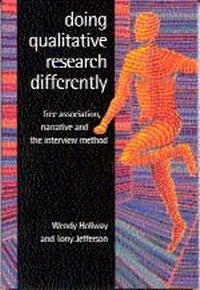
Doing Qualitative Research Differently
Free Association, Narrative and the Interview Method
1. Auflage
Erschienen am 18. April 2000
Buch
Hardcover
176 Seiten
978-0-7619-6425-4 (ISBN)
Beschreibung
`The authors need to be applauded for seeking new methods of research and for raising challenging questions. This is essential reading for any qualitative researcher' - British Journal of Occupational Therapy
This is both a `how to' book and one that critically reviews many of the assumptions, claims and methods of qualitative research.
Applying a psycho-social understanding of subjectivity to research practice involves conceptualising researcher and researched as co-producers of meanings in the research relationship. The authors use the notion of the "defended subject" to indicate that people will defend themselves against any anxieties in the information they provide in a research context. To interpret interviewees' responses should entail developing a method in which narratives are central, as should a strategy of interpretation in which interviewees' free associations are given precedence over narrative coherence. The authors call this the free-association narrative interview.
They follow this approach through the phases of empirical research practice. At each stage they use examples from their own research, and end with an extended case study which demonstrates the uses of the free-assocaition interview method in representing the richness, complexity and biographical uniqueness of the research subject.
This will be an essential tool for students of qualitative research, but will also be of interest to experienced researchers who are open to doing qualitative research differently.
This is both a `how to' book and one that critically reviews many of the assumptions, claims and methods of qualitative research.
Applying a psycho-social understanding of subjectivity to research practice involves conceptualising researcher and researched as co-producers of meanings in the research relationship. The authors use the notion of the "defended subject" to indicate that people will defend themselves against any anxieties in the information they provide in a research context. To interpret interviewees' responses should entail developing a method in which narratives are central, as should a strategy of interpretation in which interviewees' free associations are given precedence over narrative coherence. The authors call this the free-association narrative interview.
They follow this approach through the phases of empirical research practice. At each stage they use examples from their own research, and end with an extended case study which demonstrates the uses of the free-assocaition interview method in representing the richness, complexity and biographical uniqueness of the research subject.
This will be an essential tool for students of qualitative research, but will also be of interest to experienced researchers who are open to doing qualitative research differently.
Rezensionen / Stimmen
`Doing Qualitative Research Differently makes a major contribution to extending and enriching the ways in which we do research within a narrative methodology' - Forum for Qualitative Social Research`The authors need to be applauded for seeking new methods of research and for raising challenging questions. This is essential reading for any qualitative researcher' - British Journal of Occupational Therapy
Weitere Details
Auflage
First Edition
Sprache
Englisch
Verlagsort
Thousand Oaks
USA
Zielgruppe
Für höhere Schule und Studium
Maße
Höhe: 234 mm
Breite: 156 mm
Gewicht
495 gr
ISBN-13
978-0-7619-6425-4 (9780761964254)
Copyright in bibliographic data and cover images is held by Nielsen Book Services Limited or by the publishers or by their respective licensors: all rights reserved.
Schweitzer Klassifikation
Weitere Ausgaben
Nachauflagen
Buch
11/2012
2. Auflage
SAGE Publications Ltd
221,26 €
Versand in 15-20 Tagen
Personen
Wendy Hollway is Emeritus Professor in Psychology at the Open University. She is a social and qualitative psychologist with a particular interest in psychoanalytic epistemology and its application to empirical research methodology. With Tony Jefferson, she co-authored Doing Qualitative Research Differently: Free Association, Narrative and the Interview Method, which explored the implications of positin a defended subject for interview research (2nd edition, 2013). In subsequent research, she has developed psychoanalytically informed methods in an empirical project on identity changes involved in becoming mothers, using principles of psychoanalytic (infant) observation in parallel with the Free Association Narrative Interview method. Her recent and current writing documents the implications of British post-Kleinian psychoanalysis for data generation, data analysis, writing and research ethics, based on longitudinal data from interviews, reflective fieldnotes, observation notes and observation seminars with 20 "becoming mothers" in Tower Hamlets. She is a co-founder of the British Psychosocial Studies Network and the European Psycho-societal Research Group. In 2011, she was a visiting Fellow at the Oslo Centre for Advanced Study, in a program entitled "Personal Development and Socio-cultural Change," directed by Profs Harriet Bjerrum Nielsen and Hanne Haavind, from which collaborations continue.
Inhalt
Introduction
The Need to Do Research Differently
Researching the Fear of Crime
Producing Data with Defended Subjects
Analyzing Data with Defended Subjects
The Ethics of Researching Psychosocial Subjects
Biography, Demography and Generalisability
A Psychosocial Case Study
The Need to Do Research Differently
Researching the Fear of Crime
Producing Data with Defended Subjects
Analyzing Data with Defended Subjects
The Ethics of Researching Psychosocial Subjects
Biography, Demography and Generalisability
A Psychosocial Case Study