

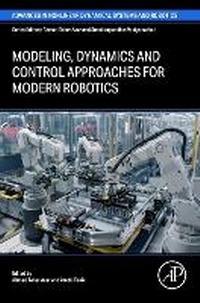
Modeling, Dynamics and Control approaches for Modern Robotics
Erscheint ca. am 1. Januar 2026
Buch
Softcover
700 Seiten
978-0-443-30106-3 (ISBN)
Beschreibung
Modeling, Dynamics and Control approaches for Modern Robotics explores and investigates various theoretical and practical principles related to modeling, dynamics, and control in robotics. The objective is to enhance the understanding and development of robotic systems by applying these principles. Through accurate representations of robot kinematics and dynamics, researchers aim to effectively analyze and predict robot behavior. This title focuses on designing algorithms and control strategies for precise and efficient robotic system management.
Additionally, the book delves into sensory feedback and perception systems for robots, advancements in autonomous vehicles, industrial automation, humanoid robots, and medical robotics, showcasing the integration of technology and computing power in modern applications. The study of control approaches and the development of optimized performance schemes are highlighted, demonstrating the significance of stability and adaptive response in changing environments. This comprehensive examination underscores the evolution and complexity of robotic systems, emphasizing their growing role in various sectors.
Additionally, the book delves into sensory feedback and perception systems for robots, advancements in autonomous vehicles, industrial automation, humanoid robots, and medical robotics, showcasing the integration of technology and computing power in modern applications. The study of control approaches and the development of optimized performance schemes are highlighted, demonstrating the significance of stability and adaptive response in changing environments. This comprehensive examination underscores the evolution and complexity of robotic systems, emphasizing their growing role in various sectors.
Weitere Details
Reihe
Sprache
Englisch
Verlagsort
San Diego
USA
Verlagsgruppe
Elsevier Science Publishing Co Inc
Zielgruppe
Für Beruf und Forschung
Maße
Höhe: 229 mm
Breite: 152 mm
Gewicht
450 gr
ISBN-13
978-0-443-30106-3 (9780443301063)
Copyright in bibliographic data and cover images is held by Nielsen Book Services Limited or by the publishers or by their respective licensors: all rights reserved.
Schweitzer Klassifikation
Weitere Ausgaben
Andere Ausgaben
Ahmad Taher Azar | Arezki Fekik
Modeling, Dynamics and Control approaches for Modern Robotics
E-Book
02/2026
Elsevier
279,99 €
Als Download verfügbar
Personen
Ahmad Azar is a Research Associate Professor at the Prince Sultan University, Riyadh, Kingdom Saudi Arabia. He is also an associate professor at the Faculty of Computers and Artificial intelligence, in Benha University, Egypt. He is the Editor in Chief of the International Journal of System Dynamics Applications (IJSDA), International Journal of Service Science, Management, Engineering, and Technology (IJSSMET), and International Journal of Intelligent Engineering Informatics (IJIEI), among others. He is currently Associate Editor of ISA Transactions, Elsevier, and the IEEE systems journal. Dr. Azar works in the areas of control theory & applications, process control, chaos control and synchronization, nonlinear control, renewable energy, computational intelligence. Arezki FEKIK is a senior lecturer at Akli Mohand Oulhadj University-Bouira, Algeria. He is a member of the International Group of System Control (IGCS), a member of the Springer conference committee and a member of the IEEE SMARTTECH conference. His current research interests include power electronics and its applications such as wind turbines, photovoltaic systems, reliability, harmonics, microgrids and variable speed drives. He has published more than 55 journal and conference articles and book chapters in the fields of power electronics and its applications.
Inhalt
1. Control Systems Principles
2. Kinematics and Dynamics
3. Sensors and Actuators control
4. System Architectures
5. Trajectory planning of a mobile robot with obstacle avoidance using conventional methods and heuristic methods
6. Hardware Implementation of a Neuro-fuzzy Controller for robotic Manipulators
7. Computed Torque Control of the PUMA 560 Robot
8. Developing Medical Robotics with AI-Enhanced Biosensors
9. Visualisation of 3D trajectory control of drones using computer aided modelling.
10. Proportional-Derivative control for nonlinear robot dynamics using adaptive finite-time approach
11. Disturbance observer based sliding mode control with fixed-time convergence for perturbed robotic manipulators
12. Drone-based image processing to detect palm tree diseases
13. Model-Based Control Strategies
14. Optimal Control Approaches
15. Robust Control Strategies for Robotics
16. Advances in Medical Robotics
17. Explainable AI for Robotics
18. Reinforcement Learning for Robotics
19. Deep Reinforcement Learning for Robotics
20. Ethics for Robotics
2. Kinematics and Dynamics
3. Sensors and Actuators control
4. System Architectures
5. Trajectory planning of a mobile robot with obstacle avoidance using conventional methods and heuristic methods
6. Hardware Implementation of a Neuro-fuzzy Controller for robotic Manipulators
7. Computed Torque Control of the PUMA 560 Robot
8. Developing Medical Robotics with AI-Enhanced Biosensors
9. Visualisation of 3D trajectory control of drones using computer aided modelling.
10. Proportional-Derivative control for nonlinear robot dynamics using adaptive finite-time approach
11. Disturbance observer based sliding mode control with fixed-time convergence for perturbed robotic manipulators
12. Drone-based image processing to detect palm tree diseases
13. Model-Based Control Strategies
14. Optimal Control Approaches
15. Robust Control Strategies for Robotics
16. Advances in Medical Robotics
17. Explainable AI for Robotics
18. Reinforcement Learning for Robotics
19. Deep Reinforcement Learning for Robotics
20. Ethics for Robotics