

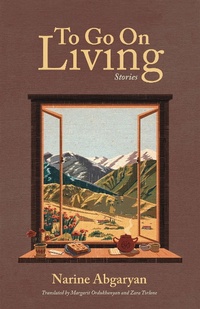
To Go On Living
Stories
Erschienen am 5. Juni 2025
Buch
Hardcover
220 Seiten
978-1-63608-152-6 (ISBN)
Beschreibung
Set in an Armenian mountain village immediately after the conflict between Armenia and Azerbaijan in the early 1990s, these thirty-one linked short stories trace the interconnected lives of villagers tending to their everyday tasks, engaging in quotidian squabbles, and celebrating small joys against a breathtaking landscape.
Yet the setting, suspended in time and space, belies unspeakable tragedy: every character contends with an unbearable burden of loss. The war rages largely off the book's pages, appearing only in fragmented flashbacks. Abgaryan's stories focus on how, in the war's aftermath, the survivors work, as individuals and as a community, to find a way forward. Written in Abgaryan's signature style that weaves elements of Armenian folk tradition into her prose, these stories of community, courage, and resilience celebrate human life, where humor and love and hope prevail in unthinkable circumstances.
Yet the setting, suspended in time and space, belies unspeakable tragedy: every character contends with an unbearable burden of loss. The war rages largely off the book's pages, appearing only in fragmented flashbacks. Abgaryan's stories focus on how, in the war's aftermath, the survivors work, as individuals and as a community, to find a way forward. Written in Abgaryan's signature style that weaves elements of Armenian folk tradition into her prose, these stories of community, courage, and resilience celebrate human life, where humor and love and hope prevail in unthinkable circumstances.
Rezensionen / Stimmen
One of Europe's most exciting authors. -The GuardianIn this vivid and harrowing linked collection, Abgaryan depicts rural life in the war-ravaged borderlands between Armenia and Azerbaijan in the early 1990s. The villagers in close-knit Berd, an Armenian mountain community, carry on despite unbearable losses. The author was born and raised in Berd, and the stories are starkly realistic and often shocking in their portrayals of sudden violence, making their moments of joy all the more remarkable. These memorable tales evoke the power of the human spirit. -Publishers Weekly
Abgaryan is a careful writer, but she's also an honest one. . . . The stories stand on their own, and are worth ruminating on as finely crafted elegies. In these ruined villages and heartbroken families, God is not an abstraction but a daily source of hope and solace. -Catholic Herald, London
Narine Abgaryan is an Armenian who writes in Russian and lives in Germany. As her Russian reader and admirer, I will say that in our literature she is one of a kind: she is absolutely at home and actually occupies one of the most venerable rooms. This book is about Armenia, a country that has seen much suffering. Yet despite describing tragic and at times terrifying events, To Go On Living contains neither desperation nor bitterness. It contains only grief, love, and hope. -Eugene Vodalazkin, author of Laurus
I was blown away by these stories of war told through the lives of ordinary folk in a small rural community. Understated and exquisite, full of compassion and humanity, humor and hope, they enrich us with their tender portrayal of resilience in the face of brutality and tragedy. Narine Abgaryan is a writer of genius. -Mary Chamberlain, author of The Dressmaker's War
Narine Abgaryan's stories describe universal pain of war that transcends boundaries and ethnicities. As an Azerbaijani, I appreciated these narratives of Armenians who lived through war between Azerbaijan and Armenia and carry its scars. The author shows how wounds of war linger from generation to generation. The everyday realities of traumatized people who have to live with memories of war and loss come alive in these pages and remind us that suffering, like love and mercy, is above politics and can be a uniting force between former enemies. -Agshin Jafarov, Azerbaijani novelist
The roughness of the language and the simple, almost understated, descriptions cause certain moments to ring out like the aftermath of an explosion . . . Abgaryan's stories weave together to paint a picture of the current landscape and a potential path forward amidst a war with no clear end. -Fare Forward
Weitere Details
Sprache
Englisch
Verlagsort
USA
Illustrationen
Not illustrated
Maße
Höhe: 230 mm
Breite: 156 mm
Dicke: 23 mm
Gewicht
442 gr
ISBN-13
978-1-63608-152-6 (9781636081526)
Copyright in bibliographic data and cover images is held by Nielsen Book Services Limited or by the publishers or by their respective licensors: all rights reserved.
Schweitzer Klassifikation
Personen
Narine Abgaryan was born in 1971 in Berd, Armenia, to a doctor and a school teacher. Named one of Europe's most exciting authors by the Guardian, she is the author of a dozen books, which have collectively sold over 1.35 million copies. Her book Three Apples Fell from the Sky won the Leo Tolstoy Yasnaya Polyana Award and an English PEN Award, and has been translated into 27 languages. Her award-winning trilogy about Manunia, a busy and troublesome 11-year-old, has been made into a TV series. Abgaryan divides her time between Armenia and Germany. Margarit Ordukhanyan, PhD, is a New York-based scholar and translator of poetry and prose from her native Armenian and Russian into English. Ordukhanyan was the Fall 2022 Translator-in-Residence at the University of Iowa's Translation Workshop and a 2023 National Endowment of the Arts Translation Fellow. She is currently a fellow at the Vartan Gregorian Center for Research in the Humanities at the New York Public Library. Zara Martirosova Torlone, a native of Armenia, is a professor in the classics department at Miami University, Ohio. She received her BA in classical philology from Moscow University and her PhD in classics from Columbia University. She is the author of Russia and the Classics: Poetry's Foreign Muse (Duckworth, 2009), Latin Love Poetry (Bloomsbury, co-authored, 2014), and Vergil in Russia: National Identity and Classical Reception (Oxford University Press, 2015), and co-edited A Handbook to Classical Reception in Eastern and Central Europe (Wiley-Blackwell, 2017) and Virgil and His Translators (Oxford University Press, 2018).